
Every sport has its jargon, and fueling is no exception. Here is every term you'll meet on a gel wall, in a training plan, or deep in a run-club debate — bonking, glycogen, isotonic, dual-source carbs, hydrogel — each explained in a couple of plain-English sentences, with a deeper guide linked wherever you want more than the definition.
B to C
Bonking (hitting the wall)
Running out of stored carbs mid-effort: glycogen empties, blood sugar drops, and pace collapses — legs like concrete, head gone foggy. It typically takes 90 minutes to two hours of hard effort to get there, which is why the marathon's wall famously lives around mile 20. Full story: what is bonking.
Caffeine (mg)
The optional layer some gels add on top of the carbs — commonly 20 to 100 milligrams per pouch. It takes about 30 to 45 minutes to fully kick in, so it's timed ahead of the hard stretch, not taken during it. How to place it: caffeine in energy gels.
Carb loading
Filling your glycogen stores before a long race: carb-forward eating — roughly 3.5 to 5.5 grams of carbs per pound of body weight per day — over the final day or three, while training tapers. In practice it's rice, pasta, potatoes, and bread doing more of the plate work, and a pound or three of water weight comes with it, because stored carbs hold water — that's the tank filling, not a problem. The full plan: how to carb load before a marathon.
Carbs per hour
The fueling budget every plan is built on: 30 to 60 grams of carbs an hour for most runners, cyclists, and triathletes, with beginners starting at 30 to 40. All sources count toward it — gels, chews, drinks, real food. The math by finish time: how many carbs per hour for a marathon.
Chia gel
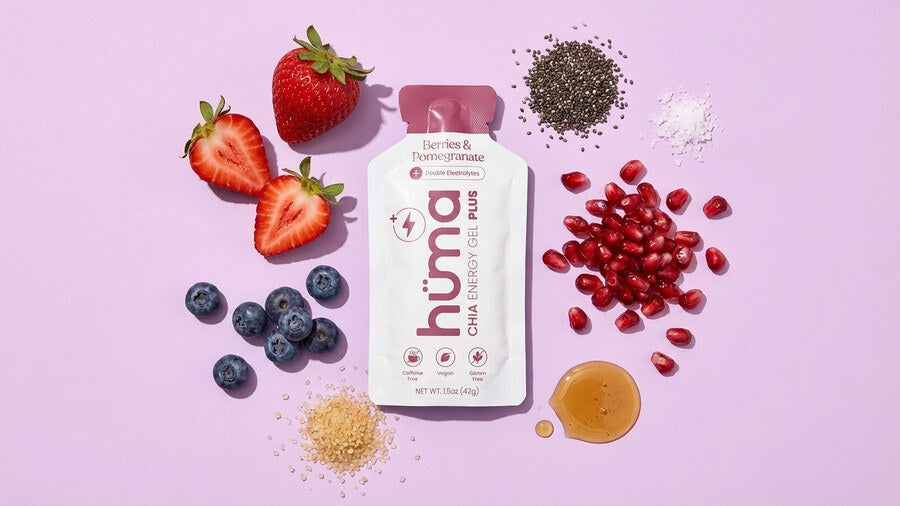
A gel with chia seeds in the formula — Hüma is the chia gel. Chia's fiber modulates carbohydrate uptake to a usable rate, and the seeds bring a little protein and healthy fats along. What the seeds actually do: what do chia seeds do in energy gels.
D to G
Dual-source carbs (glucose-fructose)
A carb blend using two sugars your gut absorbs through different doors, so they don't queue up behind each other. It's the key that unlocks hourly targets above the single-source ceiling — see 30-60-90 below.
Electrolytes
The minerals you lose in sweat — chiefly sodium. They're not fuel; carbs are the fuel, and the two jobs run on separate schedules. The split explained: electrolytes vs. carbs.
Gel (energy gel)
A single-serve pouch of fast carbs — typically 20 to 25 grams — taken with a few sips of water. The point is delivery: a known dose you can swallow in seconds at effort. The full anatomy: what's actually in an energy gel.
Glycogen
Your body's stored carbs, kept in the muscles and liver — enough for roughly 90 minutes to two hours of hard effort. Everything in fueling exists to keep that tank from hitting bottom. The basics in order: Endurance Nutrition 101.
Gut training
Practicing your race fueling on training days so your gut gets comfortable absorbing more carbs at effort. The gut is trainable like the legs — and it protests loudest when race day is its first rehearsal. How to do it: how to train your gut to absorb more carbs.
H to M
Hydrogel
A texture and delivery technology some gels use: ingredients that form a soft gel structure, intended to make a concentrated carb load easier to get down. It's a delivery method, not a different kind of carb — the carbs inside still count toward the same hourly budget as everyone else's.
Isotonic
Mixed to roughly the same concentration as your body's own fluids, so it can be taken without extra water. Genuinely isotonic gels are larger and more dilute than standard ones — and most gels aren't isotonic, so check the label rather than the vibe. The full picture: what are isotonic gels.
Maltodextrin
A processed, fast-absorbing, inexpensive carbohydrate that many synthetic gels are built on. Made industrially from starch; flavor-neutral and effective at delivering carbs. How it compares to food-based sources: real food vs. maltodextrin energy gels.
R to T
Real-food gel
A gel whose carbs come from real-food sources — fruit purees, cane sugar, honey, rice and maple syrups — rather than manufactured carbs. Honey-based gels count; the category is about the source, not one recipe. Whether they work as well: do natural energy gels work.
Semi-concentrated
A gel that carries more water than a thick, syrupy one, so it goes down lighter at effort. Hüma's real fruit purees bring that water into the formula, which is why a Hüma is semi-concentrated — though like any non-isotonic gel, it still pairs best with a few sips of water. Why concentration matters: best energy gel for a sensitive stomach.
Tear-top
The notched strip across the top of a gel pouch — tear, squeeze, done, ideally one-handed at race pace. Sounds trivial until mile 22. Technique (yes, there is one): how to open an energy gel.
The numbers: 30-60-90
30-60-90 (the carb ranges)
The three landmarks of hourly fueling: 30 to 40 grams an hour is the beginner's starting point, 30 to 60 covers most endurance athletes, and rates toward 90-plus belong to trained guts using dual-source carbs — a single carb source caps out around 60 grams an hour. Where you sit on that ladder, and how to climb it: the carb sweet spot: beginners vs. advanced.
The glossary, applied — with Hüma
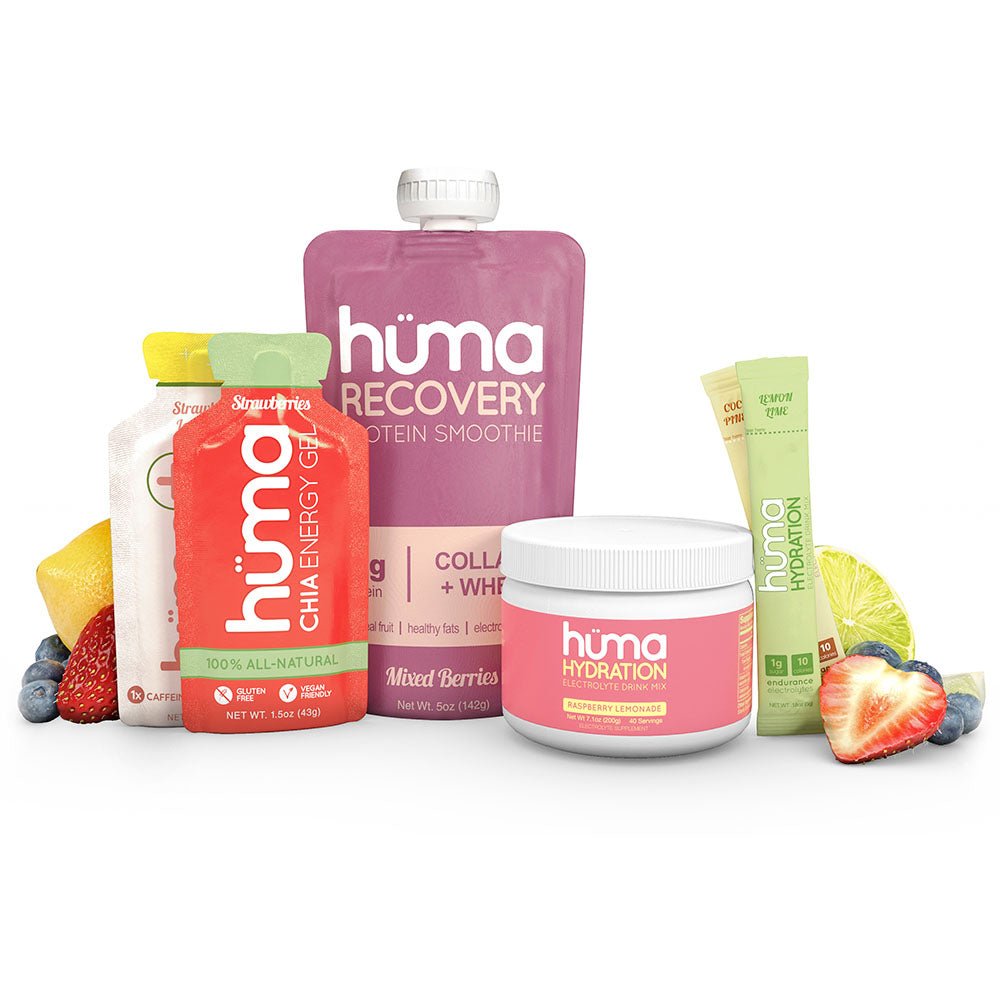
If you want the terms in one product sentence: Hüma is a real-food chia gel, semi-concentrated, at 24 grams of carbs per Original pouch — two to three per hour covers the 30-to-60 budget, each with a few sips of water. Now when the run-club debate breaks out over isotonic versus semi-concentrated, you're armed.
Related guides
- Endurance Nutrition 101: the basics of fueling
- What's actually in an energy gel?
- What is bonking?
- How many carbs per hour for a marathon
- Energy gels vs. chews vs. sports drinks
FAQ
What does bonking mean in running?
Bonking — hitting the wall — means running out of stored carbs (glycogen) mid-effort. Blood sugar drops, pace collapses, and thinking goes foggy. It typically takes 90 minutes to two hours of hard effort to empty the tank.
What does isotonic mean for energy gels?
An isotonic gel is mixed to roughly the same concentration as your body's own fluids, so it can be taken without extra water. Most gels aren't isotonic — they're more concentrated and pair best with a few sips of water.
What is maltodextrin?
Maltodextrin is a processed, fast-absorbing, inexpensive carbohydrate made industrially from starch. Many synthetic energy gels use it as their main carb source; real-food gels use sources like fruit, cane sugar, honey, and rice syrups instead.
What are dual-source carbs?
A blend of two sugars — glucose and fructose — that your gut absorbs through different doors, so they don't queue up. Dual-source fueling is what allows hourly carb intakes above the roughly 60-gram single-source ceiling.
What does gut training mean?
Practicing your race-day fueling during training so your gut adapts to absorbing more carbs comfortably at effort. Like the rest of training, it works by repetition — the gut handles best what it has rehearsed.