
Most caffeinated energy gels carry somewhere between 20 and 100 milligrams of caffeine — roughly a quarter to a full cup of coffee's worth. Take it when you need the lift most, usually at the low points late in a long effort, and always with water, exactly as you would any gel. Caffeine-free gels are just as effective for the actual fueling job, so many endurance athletes save the caffeine for when it counts.
How much caffeine is in an energy gel?
There's no single number — caffeine in gels ranges from about 20mg on the low end to 100mg or more in a high-caffeine option, with plenty of caffeine-free choices in between. For reference, a cup of brewed coffee is roughly 95mg. A gel labeled 25mg is a light nudge; one at 100mg is a real jolt you'd want to plan around. The carbs fuel you either way — caffeine is the optional extra layered on top.
How much caffeine is in each Hüma flavor?
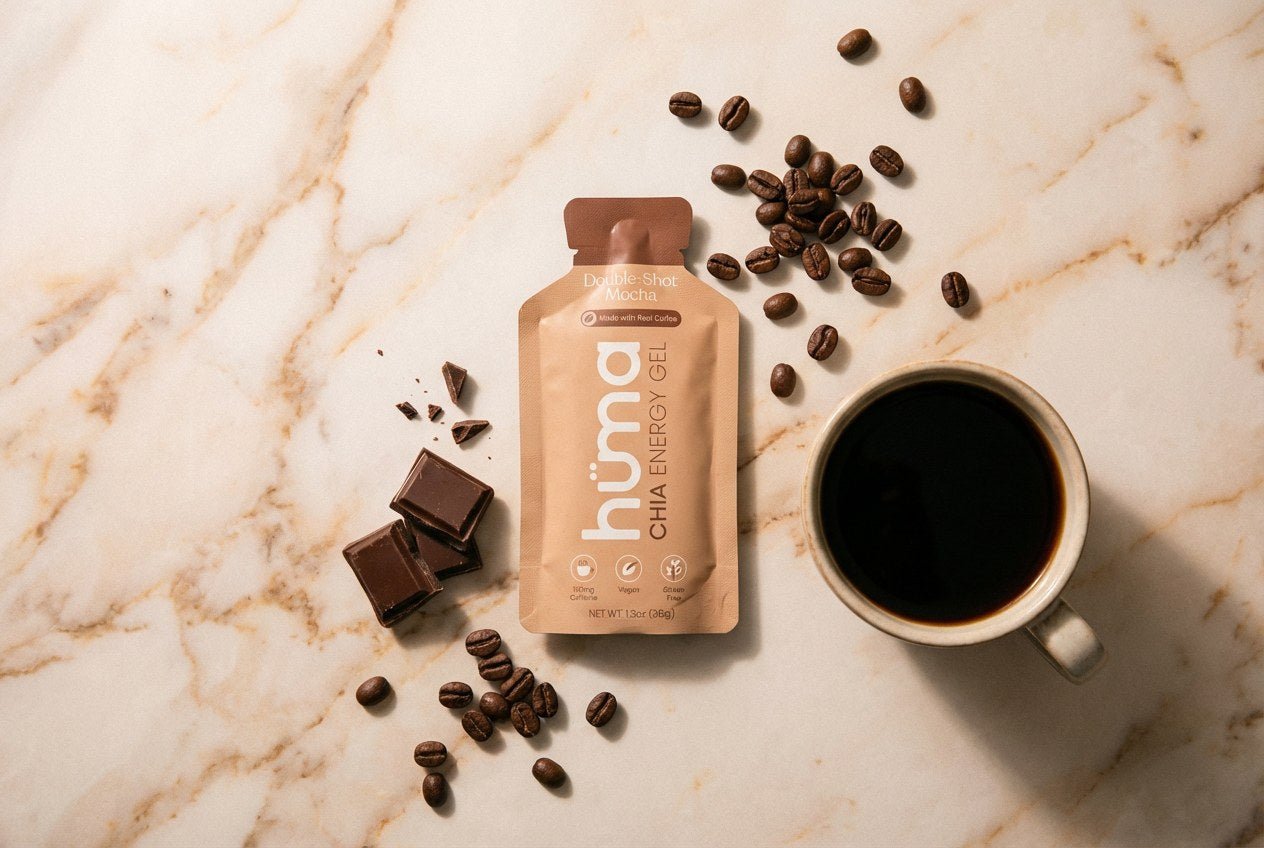
Hüma keeps it easy to plan. Seven flavors carry caffeine; six of them are a light 25mg, and Double-Shot Mocha is the strong one at 100mg. The other eight flavors are caffeine-free, so you can fuel a whole race without any caffeine at all if you prefer.
| Hüma flavor | Line | Caffeine |
|---|---|---|
| Lemonade | Original | 25mg |
| Raspberries | Original | 25mg |
| Chocolate | Original | 25mg |
| Double-Shot Mocha | Original | 100mg |
| PLUS Strawberry Lemonade | PLUS | 25mg |
| PLUS Lemons & Limes | PLUS | 25mg |
| PLUS Chocolate Peanut Butter | PLUS | 25mg |
Every other Hüma flavor — including best-seller Strawberries — is caffeine-free. You can see the full lineup in the Hüma flavor guide. (PLUS Chocolate Peanut Butter contains peanuts — check the pouch panel if you manage a food allergy.)
When should you take caffeine in a race?
Caffeine takes roughly 30 to 45 minutes to fully kick in, so timing matters. The common move for runners, cyclists, and triathletes is to save it for the low points — the back half of a long effort, a tough climb, or the stretch where focus starts to slip. Take a caffeinated gel a little before you hit that wall, not after, so it's working when you need it. If you're new to caffeine while training, rehearse it on a long session first — see when to take your first gel for how to build the timing into your plan.
Do you need water with a caffeine gel?
Yes — the same as any gel. Caffeine doesn't change the rule: a gel is a concentrated dose of carbs, and a few sips of water help it clear your stomach and absorb cleanly. Skipping water is one of the fastest ways to turn any gel, caffeinated or not, into stomach trouble. More on why in do you need water with energy gels.
Are caffeine-free gels worth it?
Absolutely. The carbs do the fueling; caffeine is a separate, optional boost. For most of a race — and for anyone who's caffeine-sensitive, fueling early in the morning, or just wants to keep their stomach calm — a caffeine-free gel does the whole job. A smart approach many athletes use is to fuel mostly caffeine-free and drop in a caffeinated gel or two at the points where the lift matters most. And because caffeine adds up across an effort, tracking your total is worth it — see can you take too many energy gels.
Planning your caffeine with Hüma
Hüma makes the math simple: six flavors at 25mg, Double-Shot Mocha at 100mg, and eight flavors with none. That lets you build a race plan deliberately — fuel with caffeine-free real-food gels through the early miles, then reach for a 25mg flavor when you want a light lift or Double-Shot Mocha when you want the strong one. Every gel is 24 grams of fast-absorbing carbs from real-food sources with chia, so the fueling stays steady whether or not there's caffeine along for the ride. Take them with water, mind your total, and time the caffeine for where it earns its place.
Related guides
- The Hüma flavor guide
- When to take your first gel — and how often after
- Do you need water with energy gels?
- Can you take too many energy gels?
- Which Hüma flavors are caffeinated?
FAQ
How much caffeine is in an energy gel?
It varies by product — most caffeinated gels fall between about 20mg and 100mg, roughly a quarter cup to a full cup of coffee's worth. Hüma's caffeinated flavors are 25mg each, except Double-Shot Mocha at 100mg, and eight Hüma flavors are caffeine-free.
When should you take a caffeine gel in a race?
Caffeine takes about 30 to 45 minutes to fully kick in, so take it a little before a low point — the back half of a long effort or a tough stretch — rather than after you've hit the wall. Rehearse the timing in training first.
Do you need water with a caffeine gel?
Yes, the same as any gel. A gel is concentrated carbs, and a few sips of water help it clear your stomach and absorb cleanly. Caffeine doesn't change that rule.
Are caffeine-free energy gels worth it?
Yes. The carbs do the fueling; caffeine is an optional extra. Caffeine-free gels handle the whole job and are a good choice for sensitive stomachs, early-morning starts, or most of a race. Many athletes save the caffeine for the points where the lift matters most.
Which Hüma flavors have caffeine?
Seven flavors: Original Lemonade, Raspberries, and Chocolate; PLUS Strawberry Lemonade, Lemons & Limes, and Chocolate Peanut Butter are each 25mg, and Double-Shot Mocha is 100mg. The other eight flavors are caffeine-free.