
An isotonic energy gel is pre-diluted — mixed to roughly the same concentration as your body's own fluids — so it's designed to go down without extra water. The trade is that the water has to live somewhere: isotonic pouches run bigger and heavier for the same carbs. If you can't get water on course, isotonic solves a real problem. If you can, a smaller, more concentrated gel carries more fuel per pocket.
What does "isotonic" mean in an energy gel?
"Iso" means "same" — an isotonic gel is mixed to roughly the same concentration as your body's own fluids. A standard gel is deliberately concentrated: a lot of carbs in a small amount of liquid, with your stomach doing the diluting — which is why gels pair with a few sips of water. An isotonic gel does that diluting at the factory instead. The water is already in the pouch — nothing left for your stomach to thin out. That's the whole trick — and it's why isotonic gels are sold as needing no water at all.
Do isotonic gels really work without water?
Yes — that's what the format is built for, and it does what it says. A few sips still rarely hurts, especially in the heat, when you're replacing sweat anyway. For every other gel, concentrated carbs absorb faster and sit easier with water — do you need water with energy gels covers the full logic.
What's the trade-off with isotonic gels?
The water has to live somewhere — and it lives in your pocket. Pre-diluting a gel means every pouch carries its carbs plus the water to thin them, so isotonic gels run bigger and heavier for the same fuel, and many carry fewer carbs per pouch than a standard gel. None of that is a flaw; it's the honest price of the convenience. But on long efforts it's real carrying math — more volume per gram of carbs. How to carry gels on a run covers that side.
Where do gels fall on the concentration spectrum?
Gels live on a spectrum, and where a gel sits sets how it goes down and how much of it you carry:
| Gel type | Water in the formula | Going down | Extra water? | Carry cost |
|---|---|---|---|---|
| Thick, syrupy gels | Very little | Dense and sticky — your stomach does the diluting | Yes — a few solid sips per gel | Smallest pouch per gram of carbs |
| Semi-concentrated real-fruit gels | More — real fruit brings its own water | Lighter and smoother | Best with a few sips | Small pouch, slightly more volume |
| Isotonic gels | The most — pre-diluted to match your body's fluids | Closest to a drink | Designed to need none | Biggest, heaviest pouch per gram of carbs |
The pattern: more water in the formula, easier going down, more to carry.
Is Hüma isotonic?
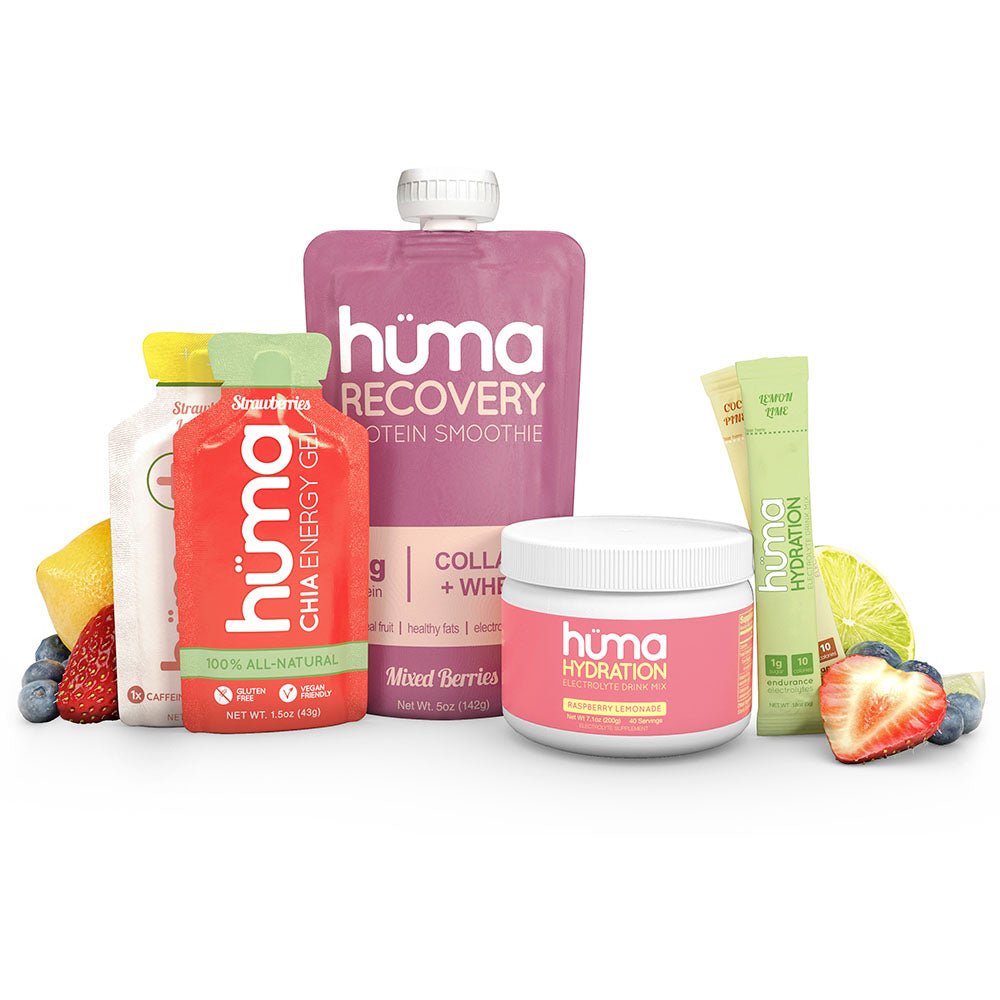
No — and it isn't a thick syrup either. Hüma's real fruit purees carry more water into the formula than a syrup-based gel, which makes it semi-concentrated at most: noticeably lighter going down, but it still pairs best with a few sips of water, like any non-isotonic gel. That's a deliberate spot on the spectrum — most of the smoothness, little of the bulk. The carbs are real food: brown rice syrup and real fruit purees and concentrates, with chia. For where a gel's carbs come from, see real-food vs. maltodextrin gels.
Should you choose an isotonic gel?
Let your water access decide. If you genuinely can't get water — a short race with no bottle, a course without aid stations, a stripped-down kit — an isotonic gel solves a real problem. If water shows up every 20 to 40 minutes — aid stations, a handheld, a vest — a smaller semi-concentrated pouch carries more fuel per pocket, and the few sips it wants line up with drinking you'd be doing anyway. Weighing gels against chews and carb drinks entirely? Gels vs. chews vs. sports drinks compares the whole field.
Fueling and fluids, with Hüma
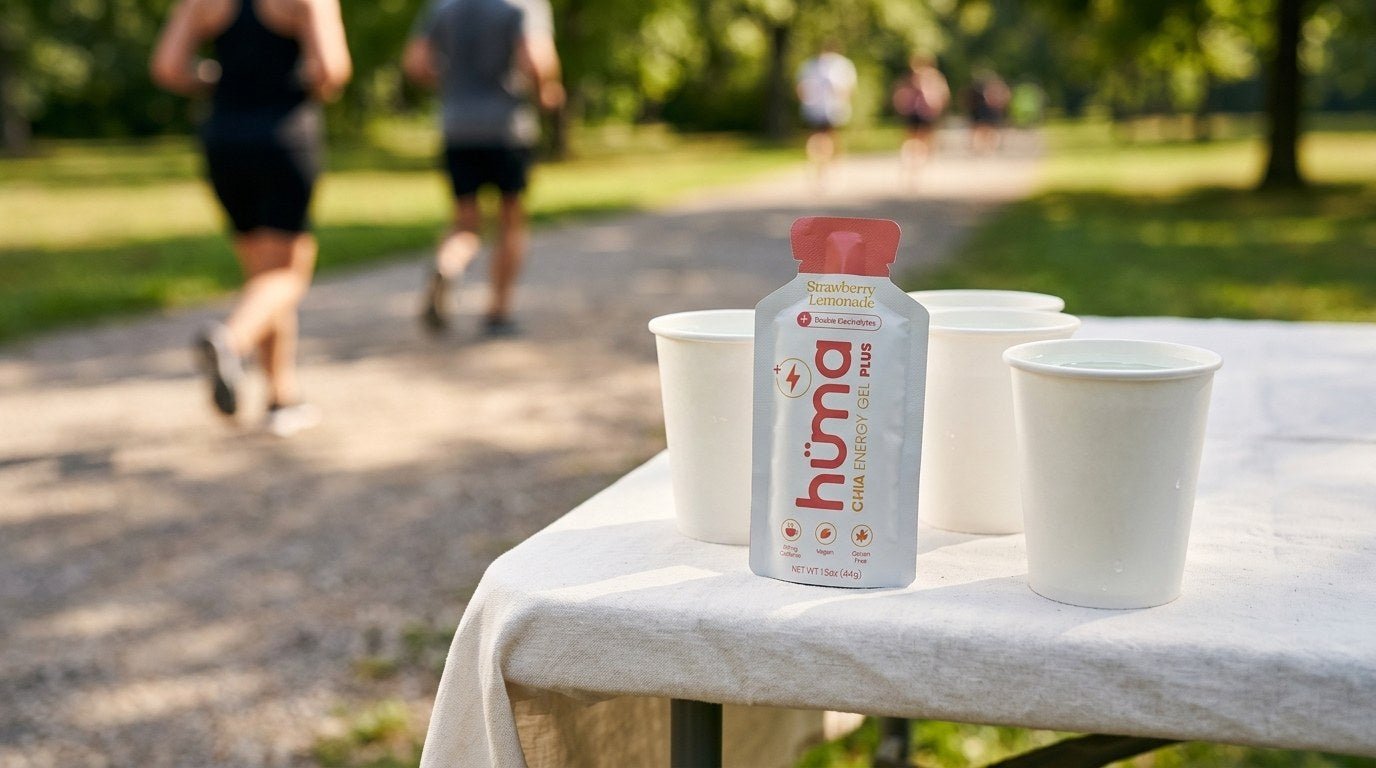
The Hüma rhythm keeps fuel and fluid on their own schedules: two to three per hour, each with a few sips of water — less than a thick syrup gel asks for, since the fruit purees already carry some of the water. On hot days, pair the gels with Hüma Hydration to put back the fluid and electrolytes you're sweating out — carbs from the pouch, fluid from the bottle.
Related guides
- Do you need water with energy gels?
- Energy gels vs. chews vs. sports drinks
- How do you carry gels on a run?
- Hüma Hydration vs. the gels: do you need both?
- Real-food vs. maltodextrin energy gels
FAQ
What is an isotonic energy gel?
A gel pre-diluted to roughly the same concentration as your body's own fluids, so it's designed to be taken without extra water. The water is in the pouch instead of in your bottle.
Do isotonic energy gels need water?
No — that's the point of the format. A few sips still rarely hurts, especially in the heat, but the gel is built to go down and absorb without any.
Are isotonic gels better than regular energy gels?
Neither is better — it's a trade. Isotonic gels skip the water but run bigger and heavier for the same carbs; concentrated gels pack more fuel into less pouch but pair best with a few sips. Your water access usually decides.
Are Hüma gels isotonic?
No. Real fruit purees carry more water into the formula than a thick syrup gel, making Hüma semi-concentrated at most — lighter going down — but it still pairs best with a few sips of water, like any non-isotonic gel.
When is an isotonic gel worth it?
When you genuinely can't get water: short races with no bottle, courses without aid stations, or a stripped-down kit. If water comes every 20 to 40 minutes, a smaller semi-concentrated pouch carries more fuel per pocket.