

Here's the honest state of the science: the core rules of fueling — how many carbs an hour, when to start, how to train your gut — aren't sex-specific, so you don't need a separate rulebook for gels. The genuinely open question is whether your menstrual cycle shifts your fuel needs across the month. The research there is mixed and individual, which makes the most useful move a simple one: track your own patterns and fuel to them.
This article is general information, not medical advice. For concerns about your cycle, hormones, or health, talk to your doctor.
Do women need different fueling advice?
For the day-to-day of fueling a long effort, no — and that's good news, not a dodge. The targets that matter are the same ones every endurance athlete works from: 30 to 60 grams of carbs an hour for most efforts, a first gel early rather than late, water alongside, and a gut you've practiced on. None of that changes because you're a woman. If you've read that women need a fundamentally different fueling approach, the everyday mechanics aren't where that plays out. Start from the universal basics — our carbs-per-hour guide and Endurance Nutrition 101 lay them out — and know they were written for you as much as anyone.
Wait — was the research even done on women?
This is a fair thing to be skeptical about, because for a long time the answer was mostly no. Sports-science research has historically leaned heavily on male participants: one large 2022 audit of performance-supplement studies found women made up under a quarter of the athletes studied, and only a small fraction of studies looked at women exclusively. So when a fueling number gets quoted as settled, remember a lot of the foundational work didn't include many women. The field has started correcting this, but the honest read today is that the universal fueling rules hold up well across sexes — while the questions specific to female physiology are the ones still being filled in.
Does your cycle change how you should fuel?
This is the real question, and it deserves a straight answer: maybe, a little, and it depends on you. Some research suggests your body's fuel mix shifts across the month — that in the luteal phase (the stretch after ovulation and before your period), you may lean slightly more on fat and slightly less on carbs at a given effort, and some women notice appetite, energy, or gut comfort moving too. That's the "known" part. The "unknown" part is whether any of it should change what you eat mid-race. When researchers test that directly, results are inconsistent — a 2026 trial found carbohydrate supplementation didn't affect endurance performance differently between cycle phases. So the picture is real metabolic shifts, but no clean, universal formula that says "eat X more in this phase." Anyone selling you a precise cycle-based fueling prescription is ahead of the evidence.
So what actually works?
Treat your cycle like any other personal variable — the way you already treat heat, sleep, or a course's hills. You don't need a study to tell you what your own body does; you need a few weeks of paying attention. The practical approach:
- Keep a simple log. Note energy, appetite, and gut comfort on your long sessions alongside where you are in your cycle. Patterns show up faster than you'd expect.
- Adjust to what you see, not to a formula. If certain days feel like you need to eat a little earlier or a little more to feel fueled, do that. If nothing changes, you've learned that too.
- Hold the fundamentals steady. The 30-to-60-grams-an-hour range, starting early, and taking gels with water don't move — they're the floor you adjust around.
- Practice it. Whatever you land on, rehearse it in training before it matters on race day.
The empowering part is that the best-studied advice is also the most universal: fuel enough, practice it, and let your own logbook be the tiebreaker. Your personal data beats any generic cycle chart online — including this one.
Fueling through your cycle, with Hüma
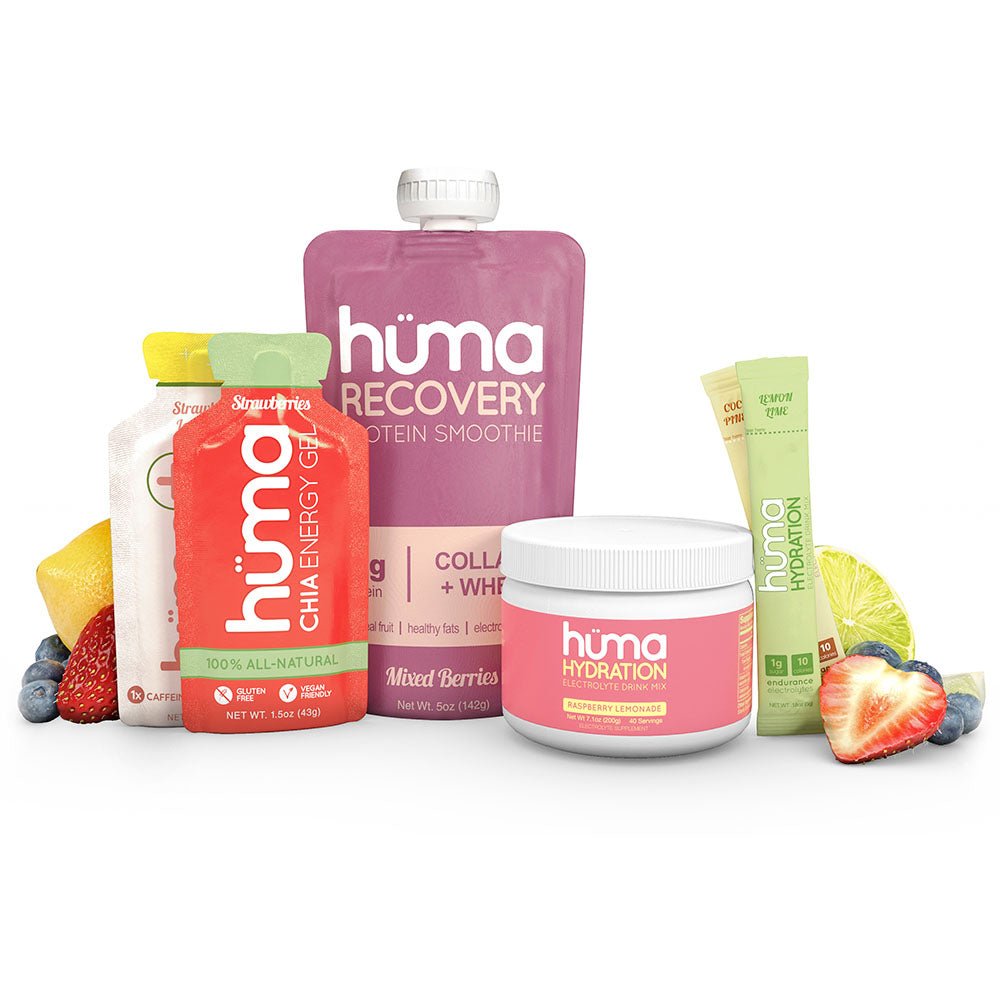
Whatever your log tells you, the gel itself stays simple. A Hüma is 24 to 25 grams of real-food carbs from brown rice syrup and real fruit purees and concentrates, with a little chia, and because the fruit carries more water into the formula, it's less concentrated going down than a thick, syrupy gel. Two to three per hour covers the standard carb budget. Pick the flavor you'll actually want to eat — taste is what gets a gel down when your stomach is picky, and that can shift week to week — starting with our best-seller Strawberries if you're not sure. And if there are days you'd rather skip caffeine entirely, 8 of Hüma's 15 gel flavors are caffeine-free; see which flavors are caffeinated to build a plan that fits how you feel that day.
Related guides
- How many carbs per hour do you need?
- How to practice gel fueling in training
- How to train your gut to absorb more carbs
- Which Hüma flavors are caffeinated?
- Endurance Nutrition 101: the basics of fueling
FAQ
Do female athletes need to fuel differently than men?
For the everyday mechanics — carbs per hour, timing, water, gut training — no. Those rules aren't sex-specific. The one area still being researched is whether your menstrual cycle nudges your fuel needs, and the evidence there is mixed enough that tracking your own patterns beats any generic formula.
How much carbohydrate should a woman take during a race?
The same well-studied range as any endurance athlete: about 30 to 60 grams of carbs an hour for most efforts, taken with water and started early rather than late. Build from that baseline and adjust to what your own long sessions tell you.
Does the menstrual cycle affect carbohydrate needs?
Some research suggests your fuel mix shifts across the month — slightly more fat, slightly less carbs in the luteal phase — but studies testing whether that changes performance or fueling needs are inconsistent. There's no reliable universal prescription, so the useful move is to log how you feel and adjust individually.
How do I fuel around my cycle in practice?
Keep a simple log of energy, appetite, and gut comfort on long sessions alongside your cycle phase, then adjust to the patterns you actually see — eating a little earlier or more on days that call for it. Hold the fundamentals steady and treat your cycle as one more personal variable.
Was fueling research done on women?
Historically, much of it wasn't — a 2022 audit found women were under a quarter of participants in performance-supplement studies. The universal fueling rules hold up well across sexes; the questions specific to female physiology are the ones still being filled in. That's a reason to trust your own logbook, not to abandon the basics.