

Yes — your gut adapts to carbs the same way your legs adapt to mileage. By practicing your fueling on long runs and gradually taking in a little more over a few weeks, you teach your gut to absorb more without distress. Most endurance athletes do fine at two to three gels per hour; gut training is how the ones going long or fast push past that ceiling.
Can you really train your gut?
You can. Your gut isn't fixed — the system that moves carbs from your intestine into your bloodstream, and your stomach's tolerance for fuel at pace, both adapt to repeated practice. Athletes who regularly fuel at high rates can take in far more carbs comfortably than someone who never practices. Like any training adaptation, it builds over a few weeks of consistent exposure, and it fades if you stop — so it's something you maintain through a race build, not a switch you flip once.
Why there's a ceiling
There's a limit to how fast carbs can cross from your gut into your blood. From a single type of carb — glucose alone — you top out around 60 grams per hour; beyond that the excess just sits in your stomach and causes trouble. Using a mix of glucose and fructose, which absorb through different pathways, lets trained athletes reach roughly 90 grams per hour or more. Part of that ceiling is set by those pathways; part of it is trainable — practice is what lets you comfortably fuel near the top of your range. For how the numbers work by distance, see how many carbs per hour you need.
How to train your gut
Gut training is simple, but it takes consistency. The approach most endurance athletes — runners, cyclists, and triathletes — use:
- Practice on every long run. Fuel with the same gels and timing you'll race with, so your gut rehearses the real thing.
- Start where you're comfortable and build slowly. Often that's two gels an hour; add roughly 10 to 15 grams — about half a gel — every week or two.
- Fuel at race pace. Your gut behaves differently easy versus hard, so practice taking carbs at the intensity you'll actually race.
- Use a mix of carb sources. Glucose and fructose together absorb better than glucose alone, which is part of how you get past 60 grams an hour.
- Take every gel with water. It helps the carbs absorb and sit easier — more on that in do you need water with energy gels.
Avoiding stomach trouble while you build
Push too much too soon and your stomach pushes back. Add carbs gradually rather than jumping to a high rate, always take gels with water, and never test a new fueling rate for the first time on race day — rehearse it in training first. Real-food gels that carry more water tend to sit easier as you ramp up. If gels still bother you, start with the underlying causes in why energy gels upset your stomach.
Who actually needs to train their gut?
Not everyone. For a half marathon, or a steady marathon, two to three gels per hour is plenty and most athletes never need to push higher. Gut training matters most for marathoners chasing a fast time, and for ultras and long-course triathlon, where hours of high-rate fueling decide how the back half feels. If that's you, build the tolerance deliberately in training — if it's not, don't force more carbs than you need.
Training your gut with Hüma
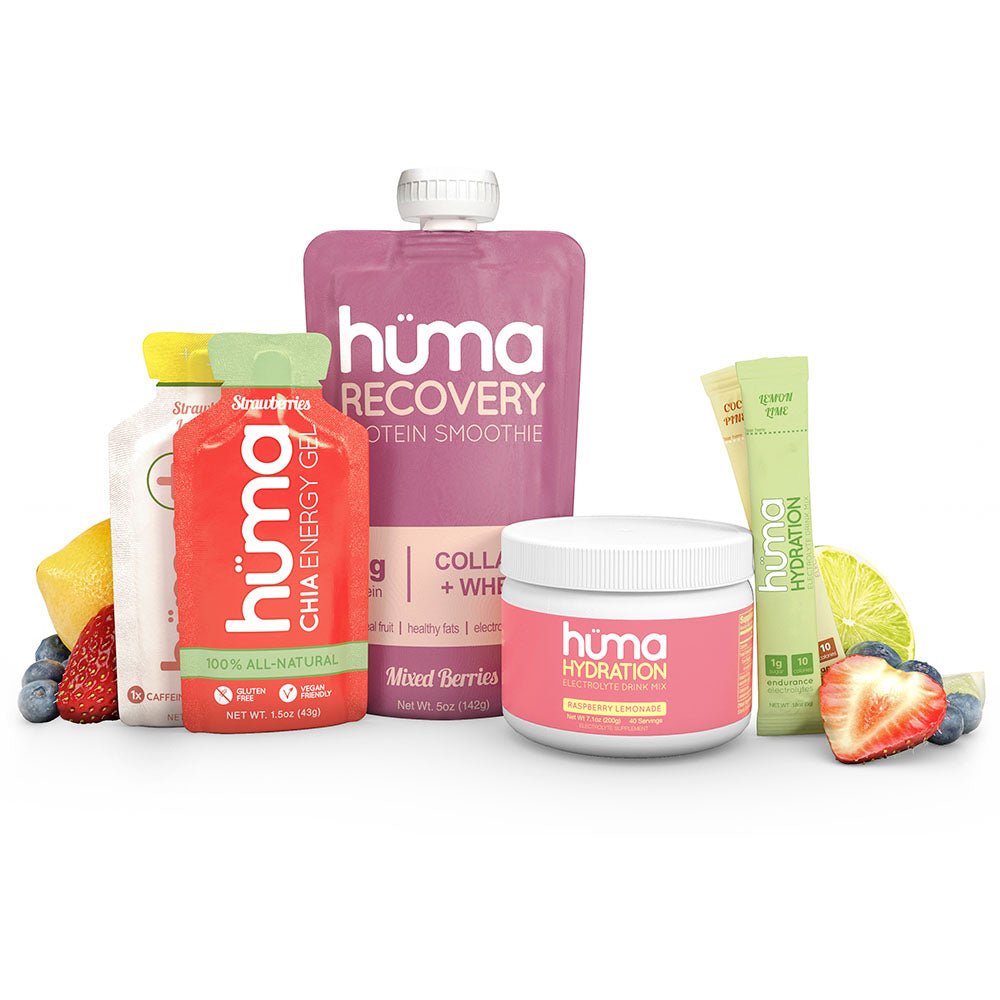
Hüma's real-food carbs come from brown rice syrup and real fruit, so you get both glucose and fructose — the two that absorb through different pathways. There's more water in the formula than a thick, syrupy gel, and chia's fiber modulates carbohydrate uptake to a usable rate, which is part of why many athletes find Hüma sits easier as they build their fueling up. Start at two to three per hour with water, add gradually week over week, and reach for Ultra — 40 grams of real-food carbs per pouch — when you want more carbs in a single gel on the longest days.
FAQ
Can you train your gut to handle more carbs?
Yes. Practice fueling on your long runs and add a little more every week or two — the gut adapts to repeated exposure like any other system, building tolerance over a few weeks.
How long does gut training take?
A few weeks of consistent practice. The adaptation fades if you stop, so keep fueling through your race build rather than training your gut once and leaving it.
How many carbs can your gut absorb per hour?
About 60 grams per hour from a single carb source like glucose, and up to roughly 90 grams per hour or more with a glucose-and-fructose mix in trained athletes.
Do most runners need to train their gut?
No. Two to three gels per hour covers most half and marathon efforts. Gut training matters most for fast marathons, ultras, and long-course triathlon.
How do you avoid stomach trouble while training your gut?
Add carbs gradually, take every gel with water, practice at race pace, and don't try a new high fueling rate for the first time on race day.