
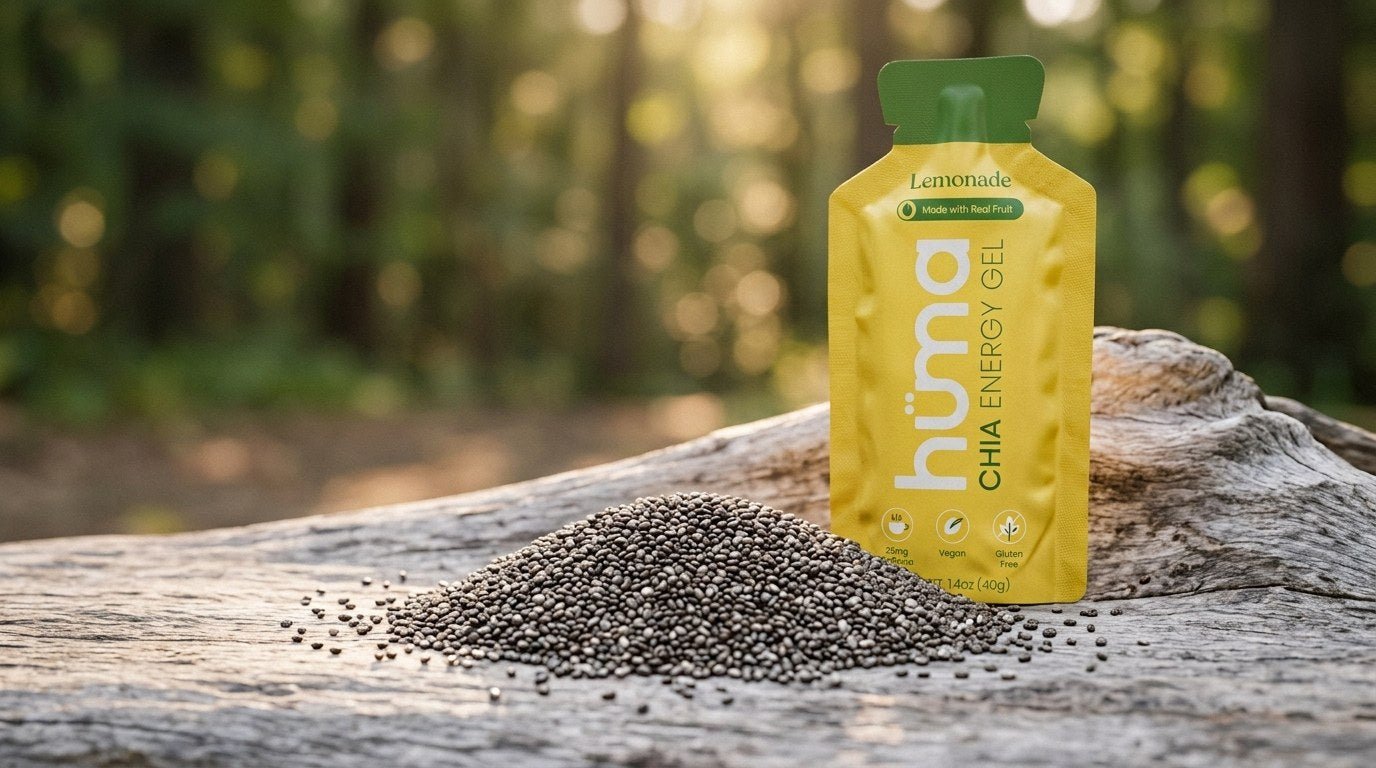
Chia is Hüma's signature ingredient — the one thing that makes it a chia energy gel. Its fiber modulates carbohydrate uptake to a usable rate, so the carbs arrive steadily instead of all at once, and it adds a little protein, omega-3s, and water-holding that help the gel sit easier. Chia isn't a carb source itself — it contributes almost no net carbs. It's there to shape how the rest of the gel goes down.
What are chia seeds, and why are they in an energy gel?
Chia seeds are tiny real-food seeds that carry fiber, a little plant protein, omega-3 fats, and a striking ability to hold water — soak them and they swell into a gel. Hüma has built its gels around chia seed powder since 2012, which makes it the one real-food chia gel in the category. The seeds don't fuel you directly; they change the texture and the way the fuel behaves, which is exactly the point of putting them in.
What does chia actually do in the gel?
Chia earns its place through four contributions, none of them a carb:
- Fiber that modulates carbohydrate uptake to a usable rate. The carbs in the gel come from real-food sources; chia's fiber helps meter how quickly they cross into your system, so you get a steadier delivery rather than one sharp hit.
- Omega-3 fats — a real-food fat that rounds out the ingredient story, coming straight from the seed.
- A little protein — a small amount per pouch, part of what makes chia a real-food inclusion rather than a flavorless additive.
- Water-holding for hydration and body. Chia holds water, which is part of why Hüma carries more water in the formula and less of the thick, concentrated feel of a syrupy gel.
Is chia a carb source?
No. This is the common misread. The carbs in a Hüma gel come from real-food sources — brown rice syrup, plus real fruit purees and concentrates for flavor. Chia contributes essentially zero net carbs at the dose in a pouch. It's fiber, fat, protein, and water-holding — a modulator, not a fuel. If you're counting the carbs you're taking on per hour, the chia doesn't move that number; the carb sources do.
How chia compares to the other parts of a gel
| Component | What it does | Is it a carb source? |
|---|---|---|
| Real-food carbs (brown rice syrup) | The actual fuel — fast-absorbing energy | Yes |
| Real fruit purees & concentrates | Flavor and a minor share of natural sugars | Minor |
| Chia seed powder | Modulates uptake to a usable rate; adds omega-3s, protein, water-holding | No (~0g net carbs) |
| Sea salt | Sodium | No |
Why chia helps the gel sit easier
Two things about Hüma's formula make it gentler on the gut, and chia is behind both. First, the fiber modulates carbohydrate uptake to a usable rate, so the carbs don't arrive as one concentrated rush. Second, chia's water-holding is part of why there's more water in the formula and less of the syrupy concentration that can back up in your stomach. That's the same reason gels can upset your stomach when they're too concentrated and taken with too little water — a gentler formula is easier to keep down deep into a long effort.
What chia means for real-food fueling with Hüma
Chia is what makes Hüma a real-food gel rather than a flavored carb syrup. Every flavor across Original, PLUS, and Ultra is built around chia seed powder — real-food carbs from real-food sources, with chia modulating how they land. The real-food half of that sentence is its own draw: many athletes want fuel built from ingredients people have eaten for a very long time — seeds, fruit, rice, cane sugar — instead of newer manufactured carbs with a short history, and that's their standard to set, not a scientific finding. A gel built from food also means a training block never asks them to make an exception to it. For runners, cyclists, and triathletes who want fuel that goes down smooth over a long day, it's the difference between a gel you dread and one you reach for again at the next aid station. Take two to three per hour with water, and let the formula do its job.
Related guides
- Real food vs. maltodextrin energy gels
- What's actually in an energy gel
- Why energy gels upset your stomach
- The Hüma flavor guide
- Is there an energy gel made from real fruit?
FAQ
What do chia seeds do in an energy gel?
In Hüma, chia's fiber modulates carbohydrate uptake to a usable rate, so the carbs arrive steadily. Chia also adds omega-3s, a little protein, and water-holding that gives the gel more water and helps it sit easier. It's a modulator, not the fuel itself.
Do chia seeds add carbs to the gel?
No. Chia contributes essentially zero net carbs at the dose in a pouch. The carbs come from real-food sources like brown rice syrup, plus real fruit. Chia is fiber, protein, omega-3s, and water-holding.
Why does Hüma put chia in its gels?
Chia is Hüma's signature ingredient — it makes Hüma the one real-food chia gel. Its fiber modulates how the carbs are taken up, and its water-holding is part of why the formula carries more water and goes down smooth.
Does chia make the gel absorb slower?
No — chia modulates carbohydrate uptake to a usable rate, meaning steadier delivery rather than one sharp hit. The carbs in Hüma are still fast-absorbing real-food carbs; chia shapes how they land, it doesn't hold them back.
Are chia seeds good for endurance athletes?
Chia brings fiber, plant protein, omega-3 fats, and water-holding in a real-food form. In an energy gel it helps the fuel go down smooth and deliver steadily, which is why runners, cyclists, and triathletes tend to find a chia gel easy to keep down over a long effort.