
Yes, energy gels work for soccer, tennis, basketball, and every other stop-start sport — the carbs don't care what sport you play. But most games under an hour don't need mid-game fuel. Where a gel genuinely earns its spot: halftime of a full-length match, tournament days with back-to-back matches, and doubleheaders that run long. A gel's carbs reach your bloodstream in 10 to 15 minutes — timed almost perfectly for a halftime break.
Do you need an energy gel for a one-hour game?
Honestly, no. At a sustained race effort, stored carbs run down in roughly 90 minutes to two hours — and a rec-league game isn't sustained effort. Stop-start play is bursts with built-in breathers: between points, throw-ins, substitutions, changeovers, timeouts. An hour of league soccer or a best-of-three club match on a normal evening doesn't drain the tank, so a mid-game gel mostly goes to waste. What does matter at every duration is showing up fueled: a normal meal a few hours before, water in the bag, done. The before-versus-during logic in should you take a gel before the race translates straight from the start line to the first whistle.
When does a gel actually help in stop-start sports?
The wins are the long days and the stacked days — the same moment-based logic that puts gels in a hiking pack (see energy gels for hiking). Fuel the hard moments, not the clock:
| Game-day moment | Why a gel works |
|---|---|
| Halftime of a full-length match | Take it at the break — the carbs land in 10 to 15 minutes, right as the second half kicks off |
| Tennis or pickleball tournament day | Multiple matches with short turnarounds, where a real meal won't sit before you're back on court — a gel tops you up between rounds |
| Doubleheaders and back-to-back games | Fast fuel between games so you start the second one with something in the tank, not a heavy stomach |
| Overtime, extra time, a third set that won't end | When the day runs long past what you fueled for, a quick 20 to 25 grams of carbs keeps you sharp for the finish |
| The gym-bag spare | A sealed gel keeps for years — see do energy gels expire — so one can live in your bag all season for the day the schedule surprises you |
Why a gel instead of a snack at halftime?
Halftime is short — ten or fifteen minutes to breathe, drink, and listen to whoever's coaching. A gel fits that window in a way a banana or a granola bar doesn't. You get a known dose — 20 to 25 grams of carbs — down in seconds, with no chewing while you're still catching your breath and nothing heavy sitting in your stomach when play restarts. And because the water comes separately, you fuel and hydrate on your own schedules instead of tying them together; do you need water with energy gels covers how the pairing works. For the full format comparison — why a gel beats chews when time is tight — see gels vs. chews vs. sports drinks. And the timing math holds up: a gel's carbs kick in within 10 to 15 minutes and carry you well into the half — how long does an energy gel last walks through it.
Does caffeine help in stop-start sports?
It can — as an optional layer on top of the fuel, never the fuel itself. The catch is timing: caffeine takes roughly 30 to 45 minutes to fully kick in, so a caffeinated gel at warm-up is peaking mid-first-half, and one at tip-off is peaking when you're already rolling. Save it for the back half of the day — the second half, the final of a tournament bracket, the nightcap of a doubleheader — so the lift arrives when the day is longest. Caffeine in energy gels covers the dosing landscape, and plenty of players skip caffeine entirely and lose nothing on fuel — are caffeine-free gels worth it makes that case.
What about hydration and electrolytes?
Fluids run on their own schedule, and in stop-start sports that schedule is usually generous — every break in play is a chance to drink. Keep it simple: water through the game, a few sips whenever you take a gel. What changes the equation is heat. A summer tournament day raises your fluid and electrolyte needs, not your carb needs — sweating harder doesn't burn more fuel, it drains more salt and water. So scale up the drinking and the electrolytes on hot days and leave the gel plan alone; hydration vs. gels sorts out which job belongs to which.
Fueling game day with Hüma
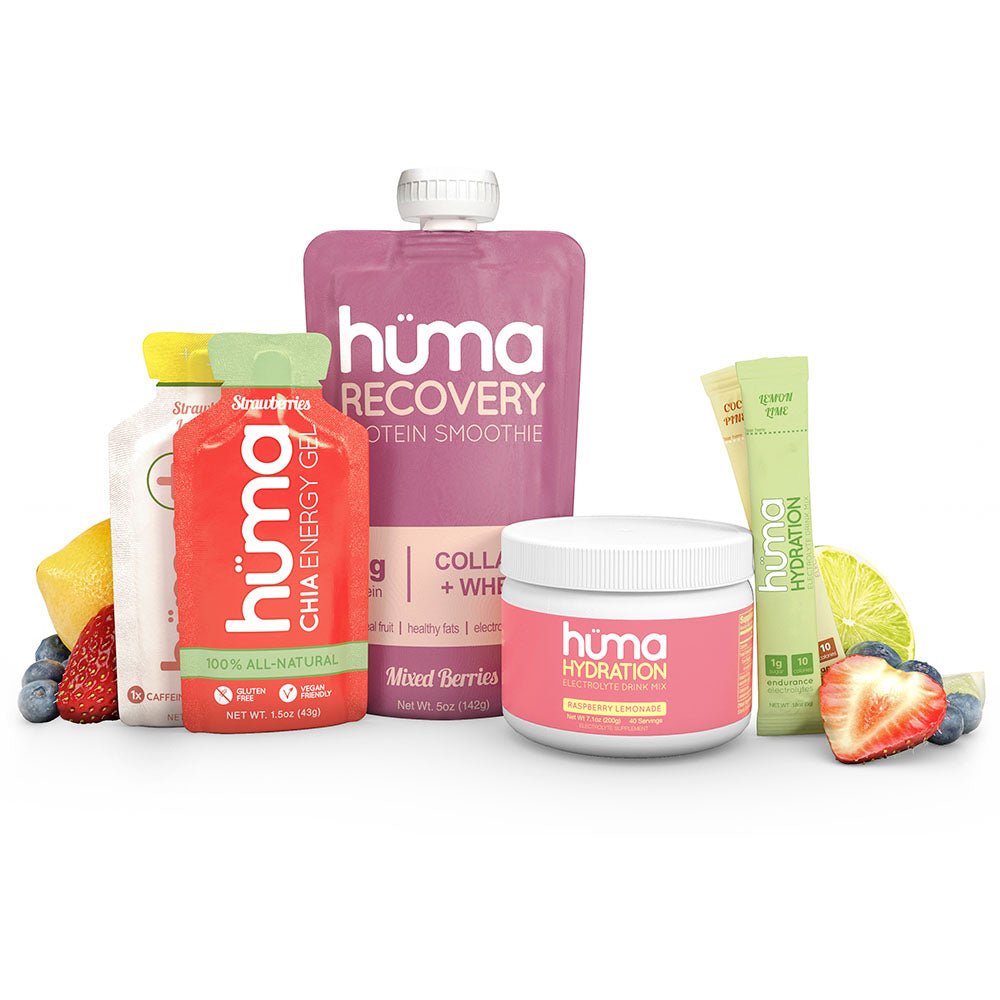
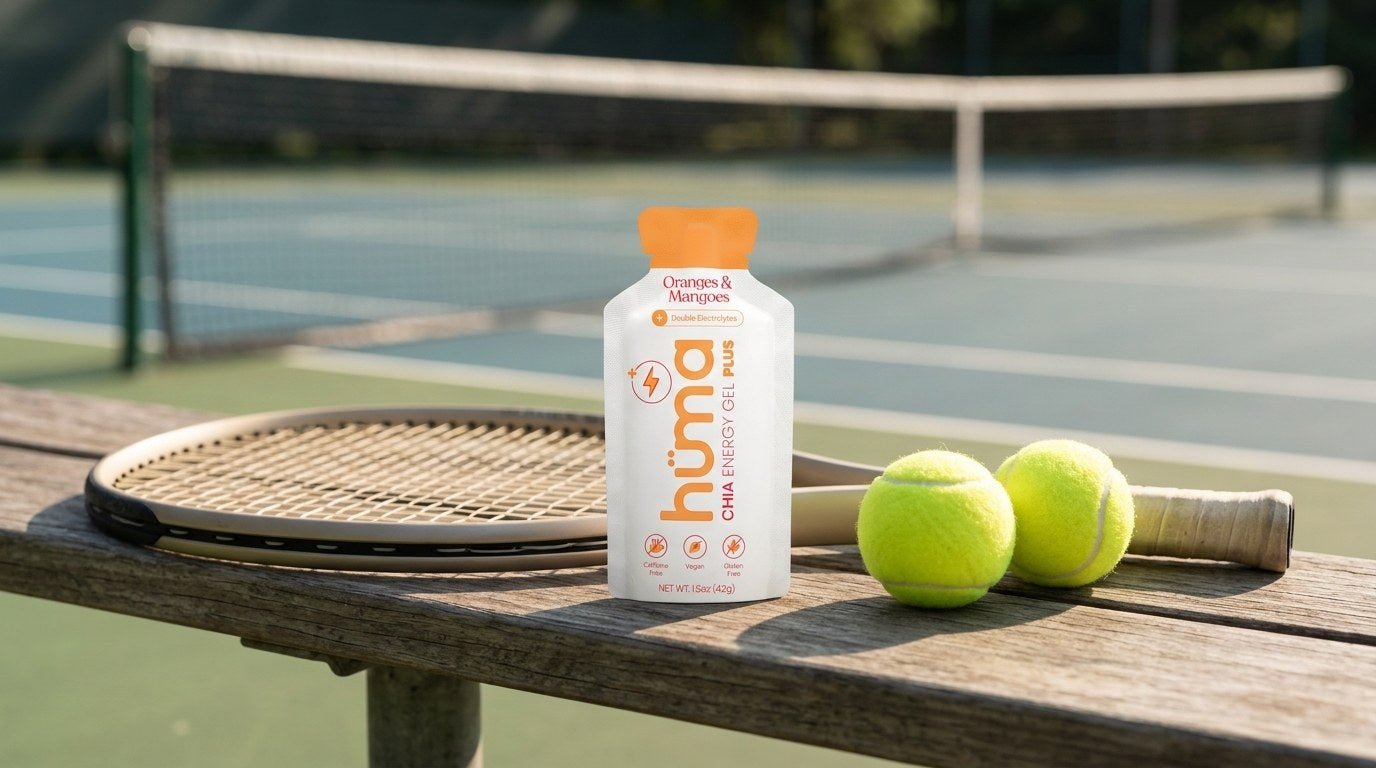
Hüma's gels are real-food fast carbs — brown rice syrup and real fruit purees and concentrates with chia — and for stop-start sports the texture is the practical win: Hüma carries more water in the formula than a thick, syrupy gel, so it goes down smooth at the halftime whistle and sits light when play restarts. Eight of the 15 gel flavors are caffeine-free, so the between-matches gel doesn't have to carry a buzz; the caffeinated flavors bring a light 25mg, and Double-Shot Mocha brings 100mg for the late final. For summer tournament weekends, PLUS doubles the electrolytes — built for hot weather, heavy sweat, and long efforts. And with a 3-year shelf life — about a year longer than most energy gels — the gym-bag spare just waits until the schedule needs it.
Related guides
- Energy gels vs. chews vs. sports drinks
- How long does an energy gel last?
- How to store energy gels (hot cars included)
- Energy gels for hiking and backpacking
- Are Energy Gels OK for Kids and Teens?
FAQ
Do you need energy gels for soccer?
Not for most games. An hour of league play runs fine on a normal pre-game meal — stored carbs cover roughly 90 minutes to two hours at sustained effort, and stop-start play burns through them more slowly. A gel earns its spot at halftime of a full-length match, in tournaments, and in doubleheaders.
When should you take a gel during a soccer match?
At the halftime break. The carbs reach your bloodstream in 10 to 15 minutes, which lines up almost exactly with the restart — you start the second half with fresh fuel instead of running on what's left of the first.
Are energy gels good for tennis tournament days?
Yes — that's one of their best uses. Multiple matches with short turnarounds leave no room for a real meal to settle, and a gel delivers a known 20 to 25 grams of carbs in seconds between rounds without sitting heavy in the next match.
Should you use a caffeinated gel for games?
It's optional. Caffeine takes about 30 to 45 minutes to fully kick in, so time it for the second half or the final rather than warm-up. Plenty of players skip it entirely — the carbs are the actual fuel, and a caffeine-free gel fuels exactly the same.
Do energy gels replace sports drinks or water?
No — gels are fuel, not hydration. Drink water through the game and take a few sips with every gel. Hot tournament days raise your fluid and electrolyte needs, not your carb needs, so scale the drinking up and keep the fueling plan the same.