

An energy gel reaches your bloodstream in about 10 to 15 minutes and covers roughly 20 to 40 minutes of effort — which is exactly why the standard cadence is one gel every 20 to 40 minutes. A pouch carries 20 to 25 grams of carbs; at a typical burn of 30 to 60 grams an hour, one gel is 20 to 40 minutes of fuel. Shelf life is a different question — covered below.
How fast does an energy gel kick in?
The carbs from a gel start reaching your bloodstream in about 10 to 15 minutes. That's fast — gels are built from fast-absorbing carbs and designed to be thinned with a few sips of water so they move through smoothly. You won't feel a switch flip; what you'll notice is what doesn't happen: the fade that was coming never arrives. One layer works on a different clock, though — if the gel is caffeinated, the caffeine takes about 30 to 45 minutes to fully kick in, so place it a little before the stretch where you want the lift.
How long does one gel keep you fueled?
Do the arithmetic and the answer falls out. A standard gel carries 20 to 25 grams of carbs. Most runners, cyclists, and triathletes burn through 30 to 60 grams of carbs an hour on a long effort — trained guts can push toward 90 with glucose-fructose mixes. Divide one gel by that burn rate and a single pouch buys you roughly 20 to 40 minutes of fueling: closer to 40 at an easy endurance pace, closer to 20 when you're racing hard and burning at the top of the range.
Why do you take a gel every 20 to 40 minutes?
Because that's the coverage window — the cadence is the arithmetic, not a ritual. If one gel covers 20 to 40 minutes, taking the next one every 20 to 40 minutes keeps the supply line unbroken. The rhythm looks like this:
- First gel: 30 to 45 minutes in — early, while your stored glycogen is still doing most of the work.
- After that: one every 20 to 40 minutes — every half hour or so, more often at race intensity.
- The logic: your glycogen stores run roughly 90 minutes to 2 hours at effort. Steady gels keep you ahead of that clock, so you're fueling for the miles ahead, not the mile you're in.
The full timing picture — first gel, caffeine placement, the last gel of a race — is in when to take your first gel, and the per-race totals are in how many gels for a marathon, half, or ultra.
What changes how long a gel lasts?
| Factor | Effect | What to do |
|---|---|---|
| Intensity | Harder efforts burn carbs faster, so each gel covers less time | Racing hard? Fuel at the 20-to-30-minute end of the window |
| Water | A gel needs dilution to absorb smoothly; without water it can sit heavier and work slower | A few sips of water with every gel |
| Gut training | A trained gut absorbs more carbs per hour, so you can run a higher fueling rate | Practice your race cadence on long training days — see how to train your gut |
Does "how long does a gel last" also mean shelf life?
It's the other half of the question, so here's the short answer: energy gels carry a best-by date — a peak-quality marker, not a hard safety cutoff — typically printed a year or two out across the category. Hüma gels carry a 3-year shelf life from the date of manufacture, about a year longer than most gels, thanks to heat processing rather than artificial preservatives. Stored cool, dry, and sealed, gels hold up well. The full storage-and-dates picture is in do energy gels expire.
Gel timing, with Hüma
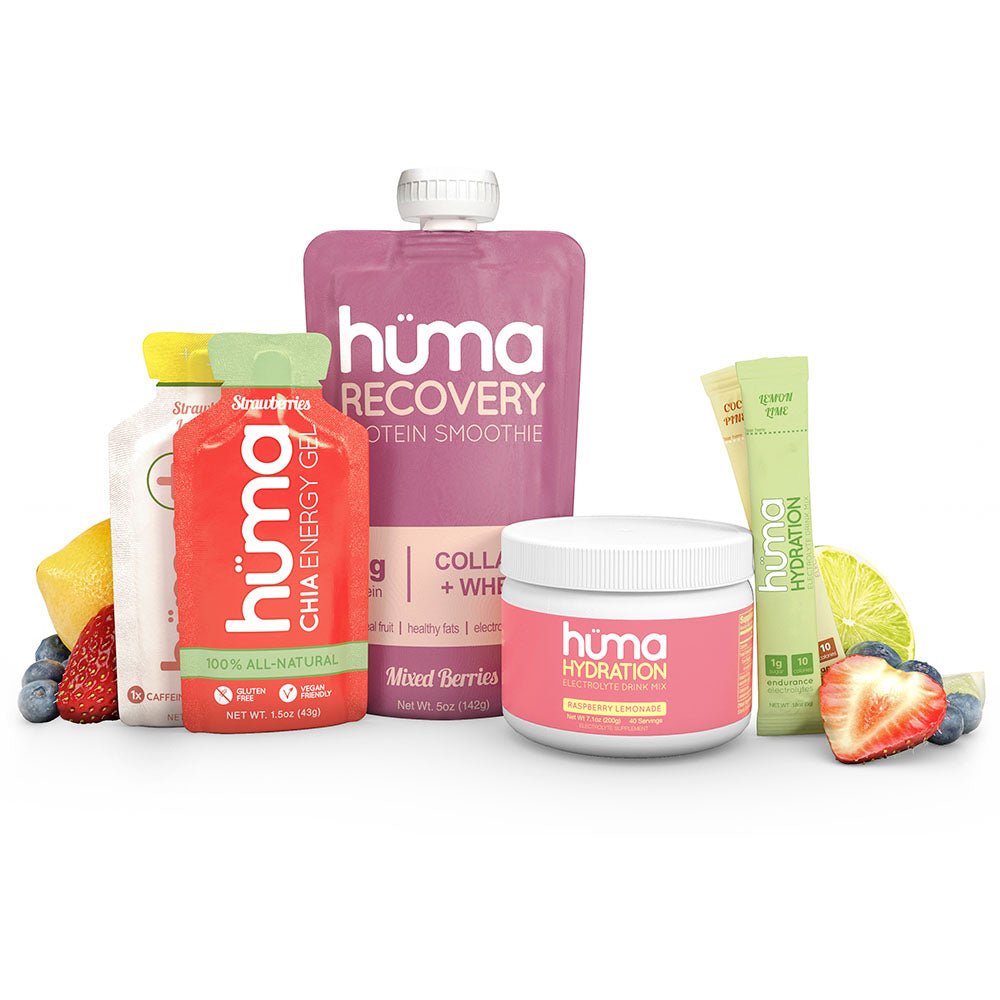
Hüma's answer to the coverage math is two to three per hour — each pouch delivers 24 grams of real-food carbs from brown rice syrup and real fruit purees, so two to three pouches an hour lands you in the 30-to-60-gram range without a calculator. The real fruit purees carry more water into the formula, so a Hüma is semi-concentrated and goes down smooth — though like any gel, it works best with a few sips of water. Want the kick-in to include a lift? The caffeinated flavors run a light 25mg (Double-Shot Mocha is the full 100mg) — taken 30 to 45 minutes before the hard part, they arrive right on time.
Related guides
- When to take your first gel — and how often after
- How many energy gels for a marathon, half, or ultra?
- Do energy gels expire?
- Energy gels vs. chews vs. sports drinks
FAQ
How long does an energy gel last after you take it?
Roughly 20 to 40 minutes of fueling. A gel carries 20 to 25 grams of carbs, and most endurance athletes burn 30 to 60 grams an hour — so one pouch covers about half an hour, less at race intensity.
How fast does an energy gel kick in?
The carbs start reaching your bloodstream in about 10 to 15 minutes. Caffeinated gels add a second layer on a slower clock — caffeine takes about 30 to 45 minutes to fully kick in.
How often should you take energy gels?
Take your first gel 30 to 45 minutes in, then one every 20 to 40 minutes after that. The cadence matches the coverage: each gel fuels about 20 to 40 minutes of effort.
How long do energy gels last on the shelf?
Gels carry a best-by date - a quality marker, not a safety cutoff - typically a year or two out. Huma gels carry a 3-year shelf life, about a year longer than most. Store them cool, dry, and sealed.
Does caffeine change how long a gel lasts?
The carbs work the same either way. Caffeine is an optional layer that takes 30 to 45 minutes to reach full effect, so take a caffeinated gel a little before the stretch where you want the lift.