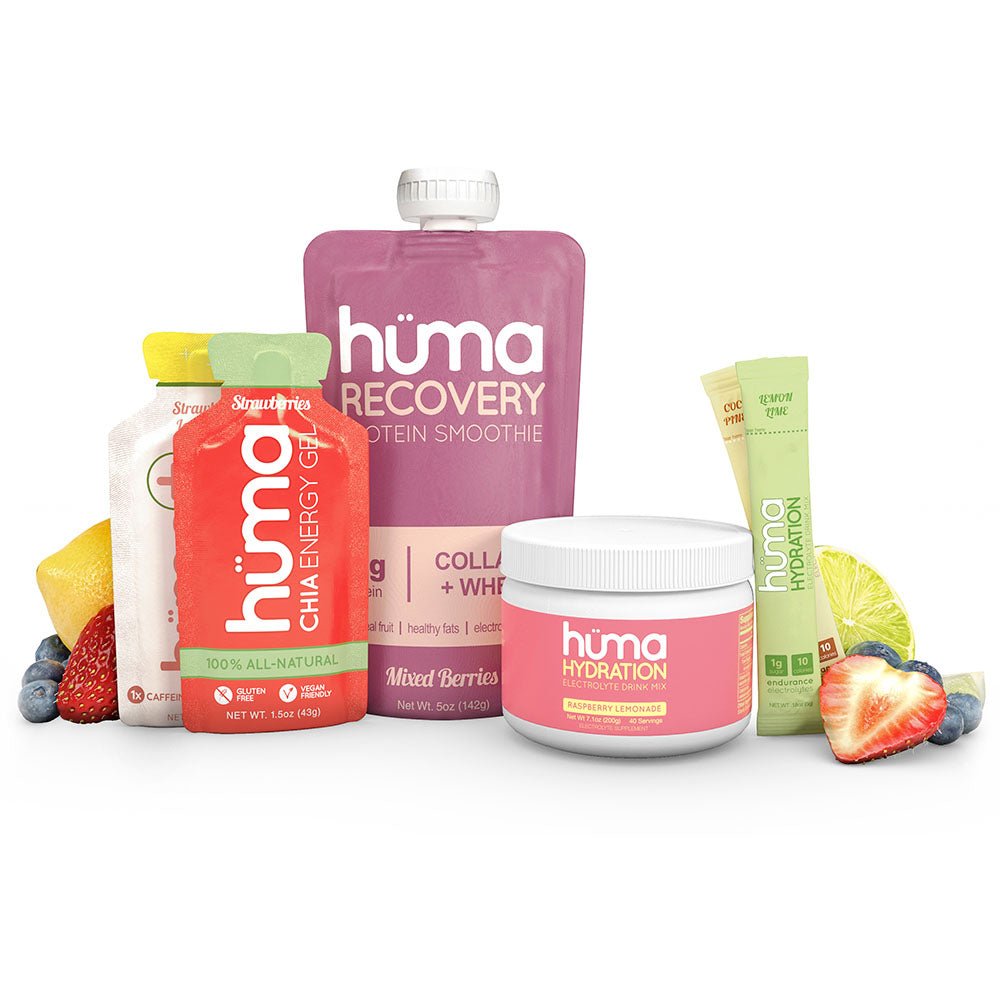


If your kid or teen is asking about energy gels, here's the honest starting point: a gel is food — fast-absorbing carbs, a little sodium, and sometimes caffeine. Whether one fits your child isn't a question a fueling guide can answer; that's a conversation for your pediatrician. What this guide can do is show what's in a gel, the ingredient worth reading the label for, and when a young athlete might use one.
This article is general information, not medical advice. Every child is different — talk to your pediatrician about what's right for yours.
What is an energy gel, exactly?
Strip a gel down and it's a small, concentrated dose of carbs your body can turn into energy quickly, plus a little sodium to replace what you sweat out — and, in some versions, caffeine. It's built to get usable carbs into the bloodstream fast during a long, hard effort. The carb source varies by brand: many gels use processed carbs like maltodextrin, while a Hüma is built from real-food sources — fruit purees, brown rice syrup, and chia. For the full parts list, see what's actually in an energy gel. The short version for a parent: it's fuel built for exercise, and the ingredient list is worth a read before anything else.
Is an energy gel the same as an energy drink?
No — and the difference is the whole point, because most of the caffeine worry attaches to the word "energy." An energy drink is built around stimulants: caffeine, often a lot of it, sometimes alongside taurine, guarana, and other additives, engineered to make you feel wired. An energy gel is built around the opposite job — replacing the carbs (glycogen) your muscles burn during a long effort. Its reason to exist is fuel, not stimulation. Some gels add a small amount of caffeine as an optional layer, but many are caffeine-free, and even the caffeinated ones usually carry a fraction of what's in an energy drink. So when pediatric guidance says "no energy drinks," it's aimed at the stimulant products — which is exactly why the caffeine line on a gel is worth reading: a caffeine-free gel is fuel, full stop, without what makes an energy drink a concern.
The one ingredient worth reading the label for: caffeine
For most parents, the real question underneath "are gels okay?" is really "does this have caffeine?" — and that's the right instinct. Plenty of gels are caffeine-free, but plenty carry it, and caffeine doesn't always show up on the front of the pouch under its own name. Across the category it can appear as guarana, kola nut, green tea or coffee extract, or tucked inside a proprietary "energy blend" — all of which are caffeine sources. So the move is simple: turn the pouch over and read the ingredient panel and the caffeine milligram figure, not just the flavor on the front. If it lists any of those, it's a caffeinated product, whatever the marketing says.
What does pediatric guidance say about caffeine and kids?
This is where a parent should lean on medical guidance rather than a fueling blog. Leading pediatric guidance — the American Academy of Pediatrics — recommends that children have no caffeine, that adolescents keep caffeine low, and that energy drinks in particular have no place in a young person's diet. We're not going to second-guess that here; we're flagging it so you know the question is real and worth taking to your child's doctor. The practical takeaway for a young athlete: a caffeine-free gel takes that whole question off the table, which is why it's the sensible default if a gel enters the picture at all.
Does a young athlete even need a gel?
Usually not — and this is worth saying plainly, because it reframes the whole question. Mid-effort fueling earns its place when an effort is long and sustained enough to run stored carbs down, which takes roughly 90 minutes to two hours of hard, continuous work. Most youth sports don't get there. A soccer match, a swim meet, a basketball game, a tennis set — these are shorter, or stop-start with built-in breaks, and a normal meal a few hours before covers them. Our guide to energy gels for team sports makes the same point for adults: most games under an hour don't need mid-game fuel. Whole food first — a real meal, water, maybe a banana — handles most of what a kid or teen is doing.
When might a gel actually fit a young athlete?
There are real cases, and they're the same long-and-sustained scenarios that put a gel in an adult's pocket — applied with a parent's judgment:
- Long tournament days. Back-to-back matches with short turnarounds, where a full meal won't settle before the next round starts, can leave a young athlete running low late in the day.
- Teen endurance athletes training seriously. A teenager doing genuinely long runs, rides, or races — the kind that stretch past that 90-minute-to-two-hour window — is fueling the same physiology an adult endurance athlete does.
- The long-day surprise. A schedule that runs longer than anyone planned — extra time, a third set, a doubleheader.
In every one of these, the decision belongs to the parent and, for anything you're unsure about, the pediatrician. A gel is one option among several — a meal, a piece of fruit, a sandwich between rounds all do a similar job. Nothing here says a young athlete should use a gel; it says if one fits, here's the shape of when.
Reading a Hüma label, with a parent's eye
If you do look at Hüma, here's what's on the panel, stated flatly so you can judge for yourself. Each Original and PLUS gel is 24 to 25 grams of real-food carbs from brown rice syrup and real fruit purees and concentrates, with a little chia and some sea salt. The ingredient lists read like food you'd recognize. On caffeine: 8 of Hüma's 15 gel flavors are caffeine-free, including best-seller Strawberries, so a caffeine-free plan is easy — see which Hüma flavors are caffeinated. Two flavors carry a nut allergen worth knowing: PLUS Chocolate Peanut Butter contains peanuts, and Ultra Apple Pie contains coconut, which the FDA classifies as a tree nut. As always, read the panel on the specific pouch — the label is the final word. For the full rundown, see Hüma dietary facts at a glance.
Related guides
- Energy gels for team sports
- Which Hüma flavors are caffeinated?
- Caffeine in energy gels: how much, and when
- Hüma dietary facts at a glance
- Endurance Nutrition 101: the basics of fueling
FAQ
Are energy gels okay for kids and teens?
Whether a gel fits your child is a decision for you and your pediatrician, not something a fueling guide can answer. What we can say factually: a gel is food — fast-absorbing carbs, a little sodium, sometimes caffeine. The ingredient worth reading the label for is caffeine, and a caffeine-free gel removes that question.
Is an energy gel the same as an energy drink?
No. An energy drink is built around stimulants like caffeine; an energy gel is built around replacing the carbs your muscles burn — it's fuel, not a stimulant. Some gels add optional caffeine and many are caffeine-free. When pediatric guidance warns against "energy drinks," it means the stimulant products, not carb-based fuel gels.
Do energy gels have caffeine?
Some do, some don't. Across the category, caffeine can appear as guarana, kola nut, green tea or coffee extract, or inside a proprietary "energy blend." Read the ingredient panel and the caffeine figure on the pouch rather than trusting the front. Eight of Hüma's 15 gel flavors are caffeine-free.
Should young athletes avoid caffeine?
Leading pediatric guidance, including the American Academy of Pediatrics, recommends against caffeine for children and energy drinks for teens. Take the specifics to your child's doctor. For a young athlete, a caffeine-free gel keeps the whole question off the table.
Does my kid actually need a gel for sports?
Usually not. Mid-effort fueling matters when an effort runs long and sustained — roughly 90 minutes to two hours of hard, continuous work. Most youth games and meets are shorter or stop-start, so a normal meal beforehand covers them. Gels fit long tournament days and serious teen endurance training.
Which Hüma flavors are caffeine-free and nut-free?
Eight of 15 gel flavors are caffeine-free, including Strawberries. On nuts: PLUS Chocolate Peanut Butter contains peanuts, and Ultra Apple Pie contains coconut, which the FDA classifies as a tree nut. Always read the panel on the specific pouch before fueling.