
Energy gels earn their spot in a hiking pack — just not on running cadence. Hiking burns carbs more slowly than running, so skip the gel-every-20-to-40-minutes schedule and save them for where the trail gets hard: steep climbs, summit pushes, and the late hours of a long day when appetite fades. A gel's carbs reach your bloodstream in 10 to 15 minutes, right when you need them.
Do you need energy gels for hiking?
Not the way runners do. Most hiking sits at an intensity your body can fuel largely from fat plus a steady stream of ordinary food — trail mix, bars, a sandwich at the overlook — so real food is the base of trail fueling, and real-food alternatives to energy gels covers that side well. The contrast with running is stark: at a sustained race effort, stored carbs run down in roughly 90 minutes to two hours, which is why runners fuel on a clock. At a walking effort those stores draw down far more slowly — so there's no two-to-three-gels-an-hour rule on the trail. But slower isn't never. The moments a hike turns into real work are exactly the moments a gel was built for.
When does a gel beat a snack on the trail?
A gel earns its spot when eating is the problem — when you can't comfortably chew, can't stop, or can't face anything bigger:
| Trail moment | Why a gel wins |
|---|---|
| Steep, sustained climb | Chewing is miserable when you're breathing hard; a gel goes down in seconds. Take it at the base — the carbs land in 10 to 15 minutes, right on time for the grind |
| Summit push | No stopping, no unwrapping, no crumbs in the wind — fuel that works while you keep moving |
| Hour eight of a long day | Appetite fades deep into big days — and up high, for many hikers. A gel goes down when the sandwich won't |
| Backpacking miles behind on calories | A fast top-up between real meals that doesn't need water to prepare or a stove to work |
| The just-in-case pocket | A sealed gel keeps for years — see do energy gels expire — so a spare can live in your pack all season |
How many gels should you carry?
Fewer than you'd carry for a run — and there's no formula worth pretending otherwise, because trail days vary too much. For a day hike with one real climb in it, a gel or two plus a spare covers most people; the snacks carry the rest. For a big mountain day or a multi-day trip, think of gels as a small per-day ration for the hardest hours, not the fuel plan itself. One placement trick worth stealing from racing: if your day has a crux — the summit ridge, the last pass — a caffeinated gel taken 30 to 45 minutes ahead of it gives the caffeine time to fully kick in.
Why do gels work so well in a pack?
The same things that make gels good race fuel make them good pack fuel. They're compact and flat, they don't melt, crumble, or care how badly they're crushed under a bear canister, and the empty pouch folds flat and packs out clean — how to open an energy gel covers the no-mess, no-litter routine. A hipbelt pocket is the natural home so fuel never requires taking the pack off; how to carry gels has more stash ideas that translate straight to hiking. Between trips, keep the stash in a cool, dry gear bin rather than the car — how to store energy gels has the details. And like anywhere else, a gel still pairs best with a few sips of water.
Fueling a hike with Hüma
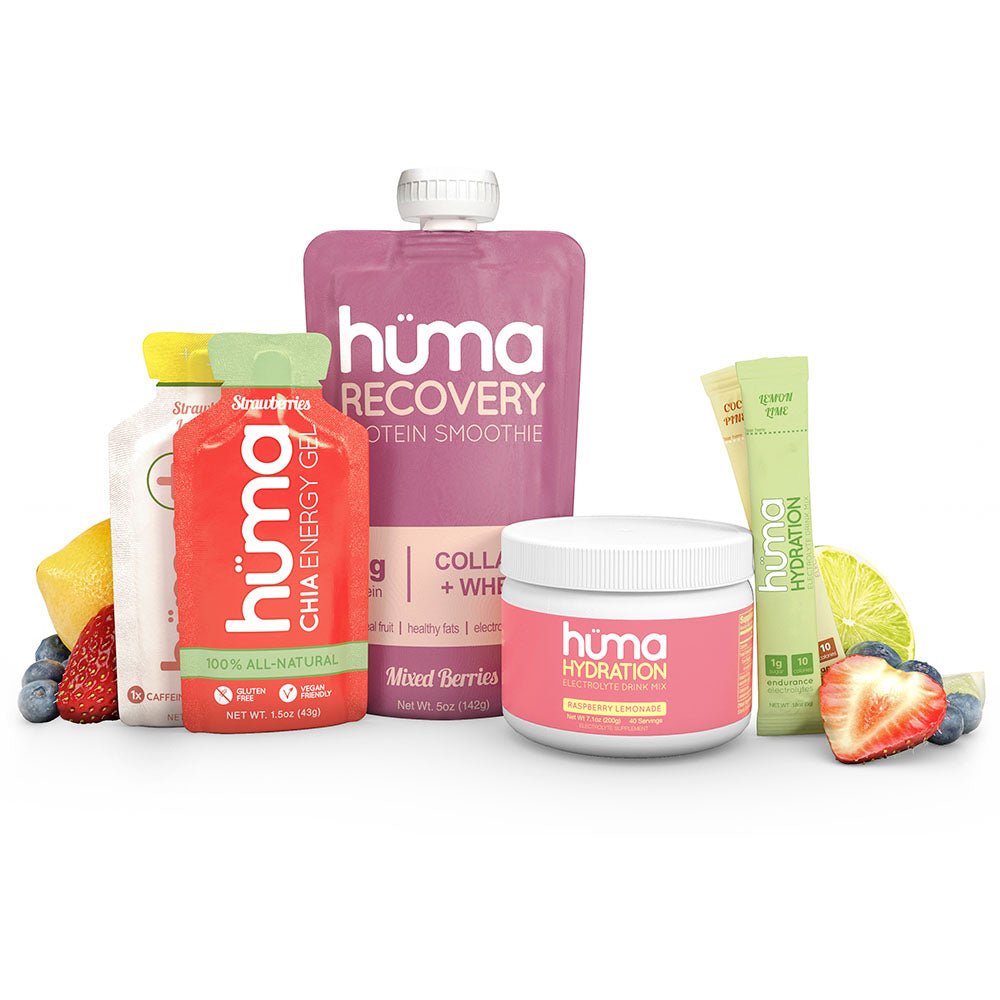
Hüma's gels are real-food fast carbs — brown rice syrup and real fruit purees with chia — and on the trail that matters for a blunt reason: at hour eight, the gel that tastes like actual fruit is the one you'll actually eat. It goes down smooth, too — Hüma carries more water in the formula than a thick, syrupy gel, so it's less concentrated going down, with a few sips from your bottle to finish the job. Eight of the 15 gel flavors are caffeine-free for the mellow miles; the caffeinated flavors carry a light 25mg for the crux, and Double-Shot Mocha brings 100mg when the alarm went off at 4 a.m. For the biggest single pushes, Ultra packs 40 grams of real-food carbs into one pouch. And with a 3-year shelf life, whatever comes home just waits in the bin for the next trip.
Related guides
- Real-food alternatives to energy gels
- How to open an energy gel without making a mess
- How to fuel for an ultramarathon
- How to carry gels on a run
FAQ
Are energy gels good for hiking?
Yes, in a supporting role. Real food carries the base of trail fueling, and gels cover the moments eating is hard — steep climbs, summit pushes, and late-day hours when appetite fades. The carbs reach your bloodstream in 10 to 15 minutes.
How many energy gels should you bring on a day hike?
Far fewer than for a run. A gel or two plus a spare covers most day hikes with a real climb; snacks handle the rest. There's no per-hour gel schedule at hiking intensity.
When should you take a gel while hiking?
At the base of a hard climb or before a summit push, since the carbs take 10 to 15 minutes to land — and late in a long day when you're behind on food but can't face a full snack.
Do you need water with a gel on the trail?
Yes — a few sips with each gel helps the carbs go down and absorb smoothly, same as on a run. Time gels for spots where your water is handy, like a hipbelt-bottle reach.
How long do gels keep in a pack or gear bin?
Sealed gels keep well past a season if stored cool and dry — check the best-by date. Hüma gels carry a 3-year shelf life from the date they're made, about a year longer than most energy gels.