
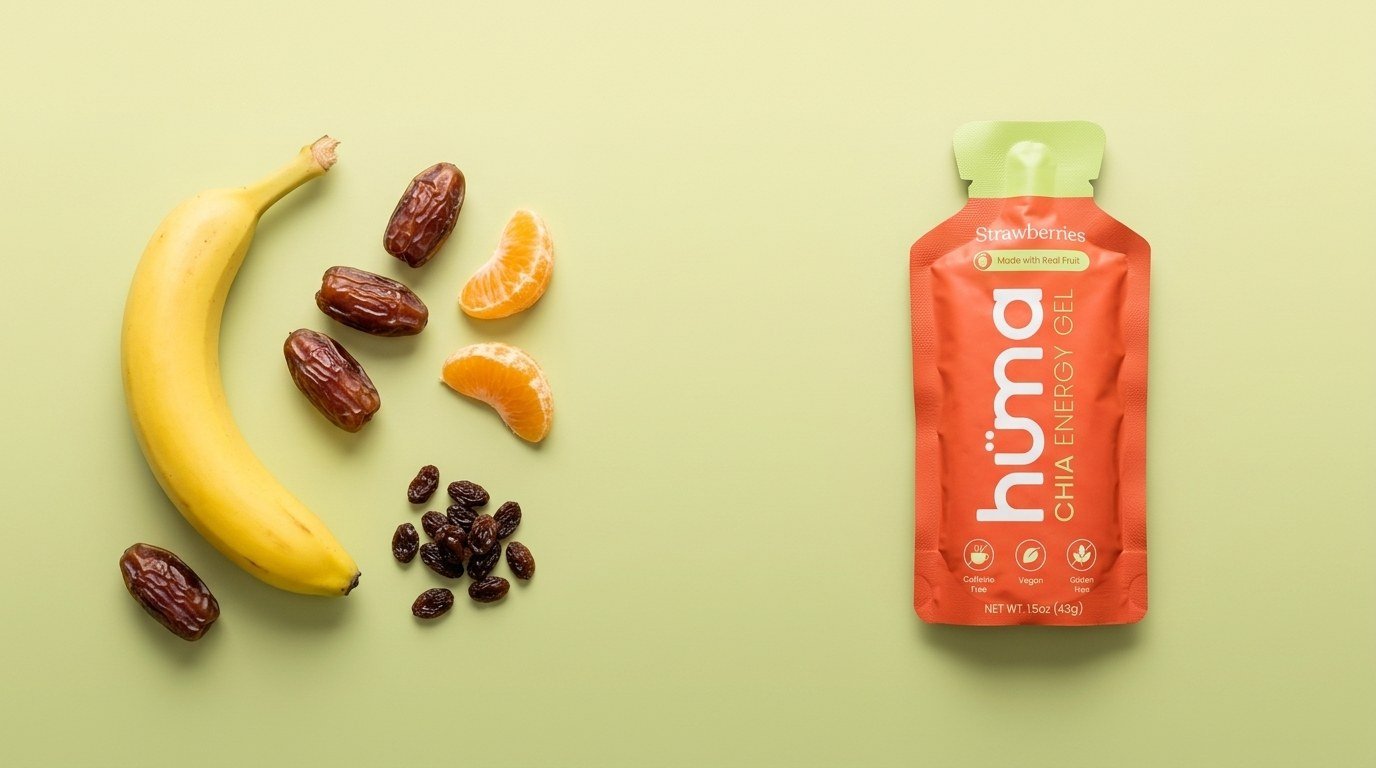
Bananas, dates, raisins, honey, and rice cakes all work as real-food fuel — they're familiar, cheap, and made of ingredients you already know. The trade-off is practicality: whole foods are bulkier to carry, harder to time precisely, and can sit heavier once the pace climbs. Gels win on being compact, fast, and easy to dose. Hüma bridges the two: real-food carbs in a gel format.
What real foods work as endurance fuel?
Plenty of everyday foods deliver the fast carbs a working body wants. A banana is the classic — soft, portable, easy on most stomachs. Dates and raisins pack a lot of carbs into a small bite. Honey is close to pure fast sugar. Rice cakes (the homemade rice-and-syrup kind or a plain store version) are a long-ride staple. The common thread is simple carbs your body can turn into energy quickly, from sources you'd recognize in any kitchen. These are the same real-food carb sources — fruit, cane sugar, syrups — that the best gels build on, just in their original form.
Real-food fuel at a glance
| Food | Approx. carbs | Best for |
|---|---|---|
| Medium banana | ~27g | Easy-to-digest carbs before or early in a long effort |
| 2 Medjool dates | ~36g | Dense, quick carbs in a small package |
| Small box of raisins (~40g) | ~32g | Portable, chewable carbs on the go |
| 1 tbsp honey | ~17g | Near-pure fast sugar; needs a container |
| 1 plain rice cake | ~7g each | Long rides where you can stash and unwrap |
| One Hüma gel (Original/PLUS) | 24g | Compact, precise, fast carbs mid-effort |
Carb figures for whole foods are approximate and vary by size and brand — check the label or a nutrition source when you're dialing in a plan. See how many carbs per hour you need to turn these into an hourly target.
Where real food wins — and where it doesn't
Real food's strengths: it's familiar and cheap, it's whole food you already eat, and for easy-paced efforts it's genuinely all many athletes need. A banana in your pocket on a long, relaxed ride is a fine plan.
Where it gets awkward: whole foods are bulky to carry, the carbs are less dense per gram, and they're harder to time precisely — you can't easily say "36 grams every hour" with a banana the way you can with a measured pouch. They also carry more fiber, which can slow how fast those carbs cross into your blood — a plus at rest, a drawback when you need fuel to arrive quickly mid-effort. As the intensity climbs, chewing and digesting solid food gets harder, and a pocket full of squashed dates is messy to manage on the move. That's exactly the gap gels were invented to fill.
Where gels win
- Compact — a lot of carbs in a small, flat pouch that fits a waistband or vest pocket.
- Fast — already a smooth, easy-to-swallow consistency; no chewing mid-stride.
- Precise — a known carb count per pouch makes an hourly plan simple to dose and repeat.
The catch has traditionally been that many gels swap the real food out for processed carbs to get that convenience. It doesn't have to be a trade-off.
Real food in a gel with Hüma
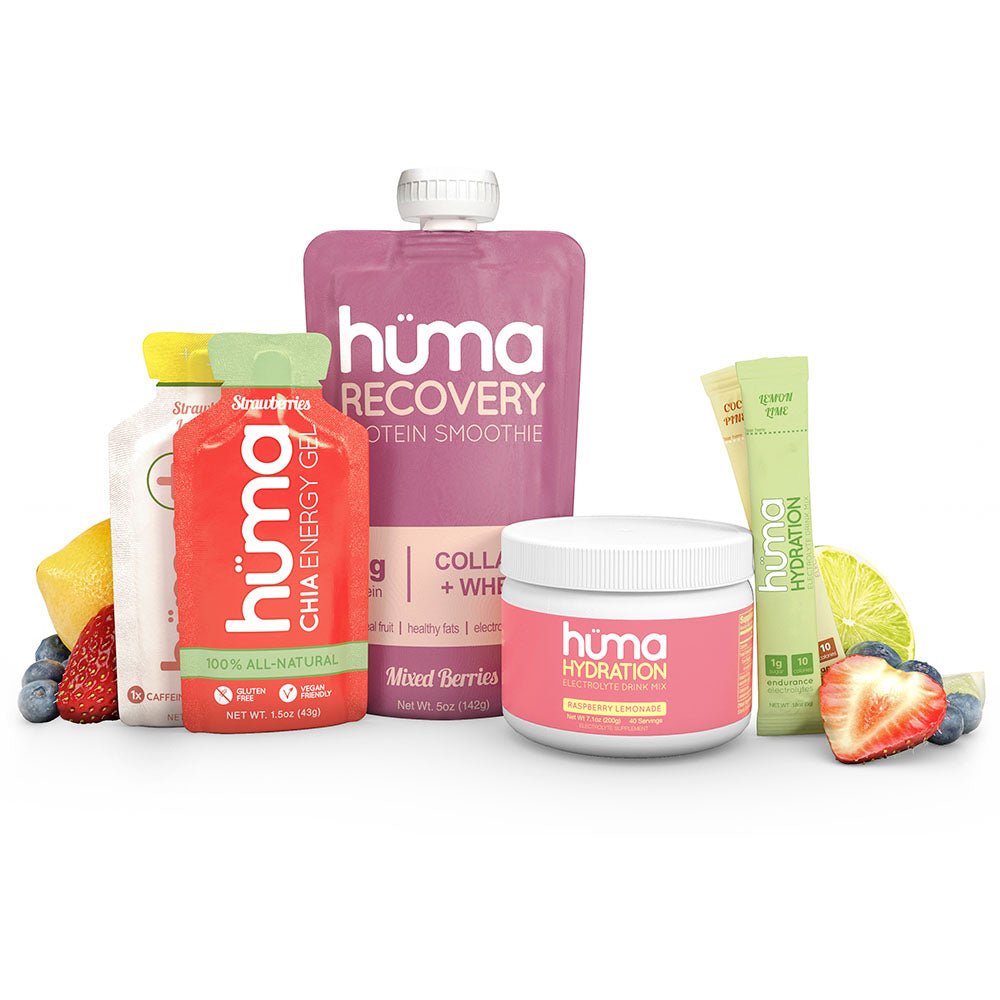
Hüma exists to close that gap: real-food carbs in a gel format. Each Original and PLUS gel is 24g of carbs from brown rice syrup and real fruit purees and concentrates, with a little chia — whose fiber modulates carbohydrate uptake to a usable rate. It's the fuel a banana or a date is made of, in a pouch that's easy to carry, quick to take, and simple to dose at two to three per hour. There's more water in the formula than a thick, syrupy gel, so it's less concentrated going in. Runners, cyclists, and triathletes get real food that keeps up when the pace does. For how the parts compare, see what's actually in an energy gel.
Related guides
- Real food vs. maltodextrin energy gels
- How many carbs per hour for a marathon
- Energy gels for hiking and backpacking
- What's actually in an energy gel?
- Is there an energy gel made from real fruit?
FAQ
What are the best real-food alternatives to energy gels?
Bananas, dates, raisins, honey, and rice cakes are the classics — familiar, cheap real foods that deliver fast carbs. They work well for easier-paced long efforts. As intensity climbs, they get harder to carry, time, and digest than a gel.
Are bananas or dates good for running?
Yes, for easy to moderate efforts. A banana is soft and easy on most stomachs; a couple of dates pack dense carbs in a small bite. The trade-off is bulk and precision — they're harder to dose by the hour than a measured pouch.
Why use a gel instead of real food?
Gels are compact, already smooth and easy to swallow, and carry a known carb count, so an hourly plan is simple to dose and repeat. That matters most at higher intensity, when chewing and digesting solid food gets harder.
Can you get real food in a gel?
Yes. Hüma's carbs come from real-food sources - brown rice syrup and real fruit purees and concentrates, with a little chia - in a pouch that's easy to carry, quick to take, and simple to dose at two to three per hour.
How much real food do you need per hour?
For most endurance athletes, roughly 30 to 60 grams of carbs per hour. That's about one to two bananas, or two to three gels. Take fuel with water and start early, before you're empty.