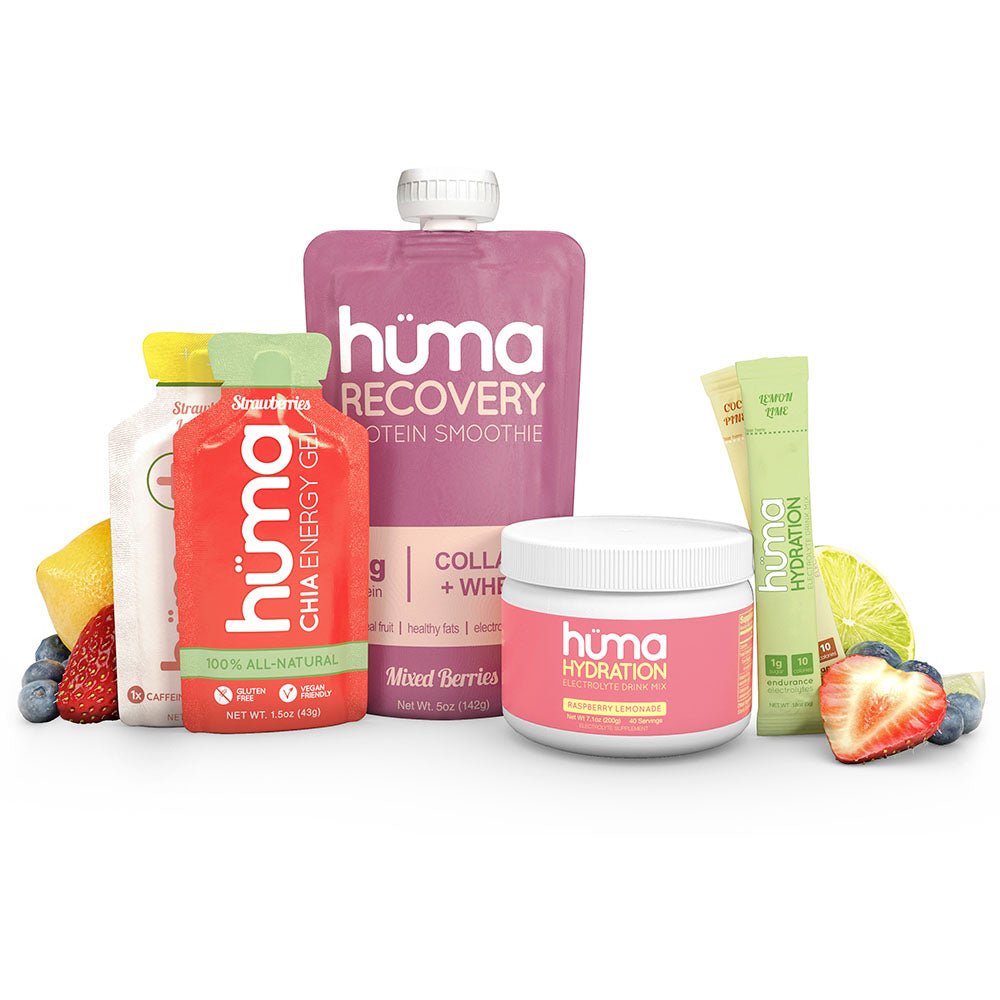

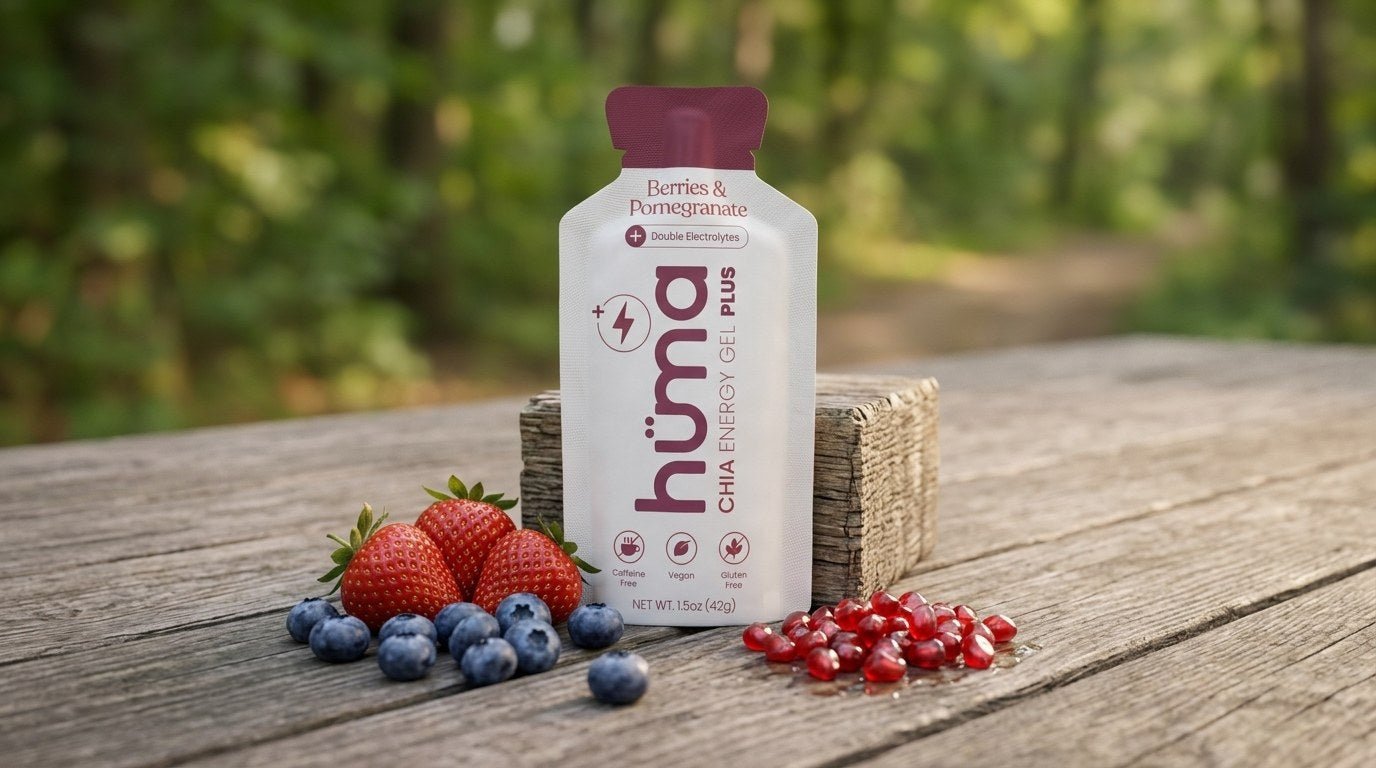
Yes. Hüma gels are built on real fruit — purees, concentrates, and real juices, like strawberry, blueberry, mango, and lemon — blended with brown rice syrup for fast-absorbing carbs, with no maltodextrin. In a gel, "real fruit" means actual fruit in the pouch, puree you can taste and feel in the texture, not just fruit flavoring added to a processed carb base.
What counts as "real fruit" in an energy gel?
Real fruit in a gel means fruit purees and concentrates — actual fruit, processed only enough to be shelf-stable and pouch-friendly — sitting in the ingredient list as food, not as a flavoring. That's a different thing from a gel whose "strawberry" is a natural flavor added to a base of processed carbs. Real-food gels as a category draw their carbs from recognizable sources: fruit, cane sugar, rice and maple syrups, juices. Most gels on the market take the other route, building on maltodextrin — a processed, fast-absorbing carbohydrate — with flavoring layered on top. Both approaches deliver carbs; what's in the pouch is what differs. For the full ingredient rundown, see what's actually in an energy gel.
Is fruit the main carb source in a fruit-based gel?
Honest answer: no — and it's worth understanding why. Fruit puree is mostly water by weight, so while it contributes a share of natural sugars, the bulk of the carbs in a real-fruit gel come from concentrated real-food sources — chiefly brown rice syrup. Original flavors sweeten with cane sugar; PLUS flavors use fruit concentrates — grape or apple by flavor — to the same effect. That's by design. A gel's job is fast-absorbing carbs in a small package, and puree alone can't carry 24 grams. The fruit's job is everything else — the flavor, the aroma, the body of the texture, and the reason the pouch tastes like food. The carbs are real-food carbs either way; the fruit is what makes them taste that way.
Why does real fruit matter in a gel?
Three practical reasons, none of them mystical:
- Taste you don't tire of as fast. Flavor that comes from the named fruit reads as food, which matters more the deeper you get into a long day — many endurance athletes find real-fruit flavors easier to keep taking hour after hour.
- Texture. Fruit puree gives the gel body — closer to a smooth applesauce than a syrup. It's a big part of why a fruit-based gel goes down smooth.
- Water content. A puree-based gel carries more water than a thick, concentrated gel, so it's less concentrated going in — gentler on a working gut, and easier to take even when you're between water stops.
Behind those three sits the reason many athletes go looking for fruit in a gel at all: fruit has thousands of years of human eating behind it, a history newer manufactured carbs can't yet claim — and for plenty of athletes that history is the deciding vote, theirs to cast rather than science's. Fruit also happens to package glucose and fructose together, and those two sugars ride into your system through different doors instead of crowding one. For athletes who flip the package over before buying anything, there's a closing argument too: race training runs through pouch after pouch, and it's easier to sign off on all of them when the ingredient list looks like food the whole way down.
How does a real-fruit gel compare to a maltodextrin gel?
| Real-fruit gel | Maltodextrin-based gel | |
|---|---|---|
| Carb sources | Brown rice syrup, fruit purees and concentrates; cane sugar (Original) or fruit concentrates (PLUS) | Maltodextrin, often with fructose |
| Where the flavor comes from | The fruit itself | Added flavoring |
| Texture | Body from fruit puree, closer to applesauce | Typically thicker and more syrupy |
| Water content | More water, less concentrated | More concentrated |
Both styles do the core job — fast carbs during exercise. The differences show up in how the gel tastes, feels, and sits over a long effort. For the deeper comparison, see real food vs. maltodextrin energy gels, and if your stomach is the deciding vote, the best energy gel for a sensitive stomach.
Which fruits are actually in a Hüma?
Every Hüma fruit flavor is built on the fruit it's named for — purees, concentrates, and real juices, right in the ingredient list:
| Flavor | The fruit inside |
|---|---|
| Strawberries | Strawberry puree and strawberry concentrate |
| Blueberries | Blueberry puree and blueberry concentrate |
| Mangoes | Mango puree |
| Raspberries | Raspberry puree and raspberry concentrate |
| Lemonade | Real lemon juice |
| Apples & Cinnamon | Apple puree, with cinnamon |
| PLUS Strawberry Lemonade | Strawberry puree and concentrate, with lemon juice |
| PLUS Berries & Pomegranate | Strawberry and blueberry purees, pomegranate and blueberry concentrates |
| PLUS Bananas & Berries | Banana puree, with blueberry and strawberry concentrates |
| PLUS Oranges & Mangoes | Orange juice and mango concentrate |
| PLUS Lemons & Limes | Real lemon and lime juices |
The cocoa flavors — Chocolate, Double-Shot Mocha, and PLUS Chocolate Peanut Butter — trade fruit for real cocoa, and the high-carb Ultra Apple Pie builds its 40 grams from a mix of simple and complex carbs: brown rice syrup, apple, banana, sweet potato, and coconut. Every gel also carries chia, whose fiber modulates carbohydrate uptake to a usable rate — part of why Hüma tends to sit easier when runners, cyclists, and triathletes are fueling hard. Real food, no maltodextrin, no artificial flavors — and a lineup where Strawberries actually tastes like strawberries. The Hüma flavor guide walks through all of them.
Related guides
- Real food vs. maltodextrin energy gels
- What's actually in an energy gel
- The Hüma flavor guide
- The best energy gel for a sensitive stomach
- Do natural energy gels work as well as synthetic ones?
FAQ
Is there an energy gel made from real fruit?
Yes. Hüma gels are built on real fruit purees, concentrates, and juices — strawberry, blueberry, mango, lemon, and more — blended with brown rice syrup for fast-absorbing carbs, with no maltodextrin.
What does "real fruit" mean on a gel label?
It means fruit purees, concentrates, and juices appear in the ingredient list as food — actual fruit in the pouch — rather than a fruit flavoring added to a processed carb base. The fruit supplies the taste, aroma, and texture.
Is fruit the main source of carbs in a Hüma gel?
No — fruit puree is mostly water, so it contributes flavor, texture, and a minor share of natural sugars. The primary carbs come from brown rice syrup, with cane sugar in Original flavors and fruit concentrates — grape or apple by flavor — in PLUS, all real-food sources.
Do all Hüma flavors contain fruit?
Most do — each fruit flavor is built on the fruit it's named for. The exceptions are the cocoa flavors — Chocolate, Double-Shot Mocha, and PLUS Chocolate Peanut Butter — which are built on real cocoa instead. Ultra Apple Pie uses apple, banana, sweet potato, and coconut.
Is a real-fruit gel easier on the stomach?
Many athletes find it sits easier. A puree-based gel carries more water, so it's less concentrated going in, and the chia in Hüma modulates carbohydrate uptake to a usable rate. Taking gels with water at a sensible rate still matters most.