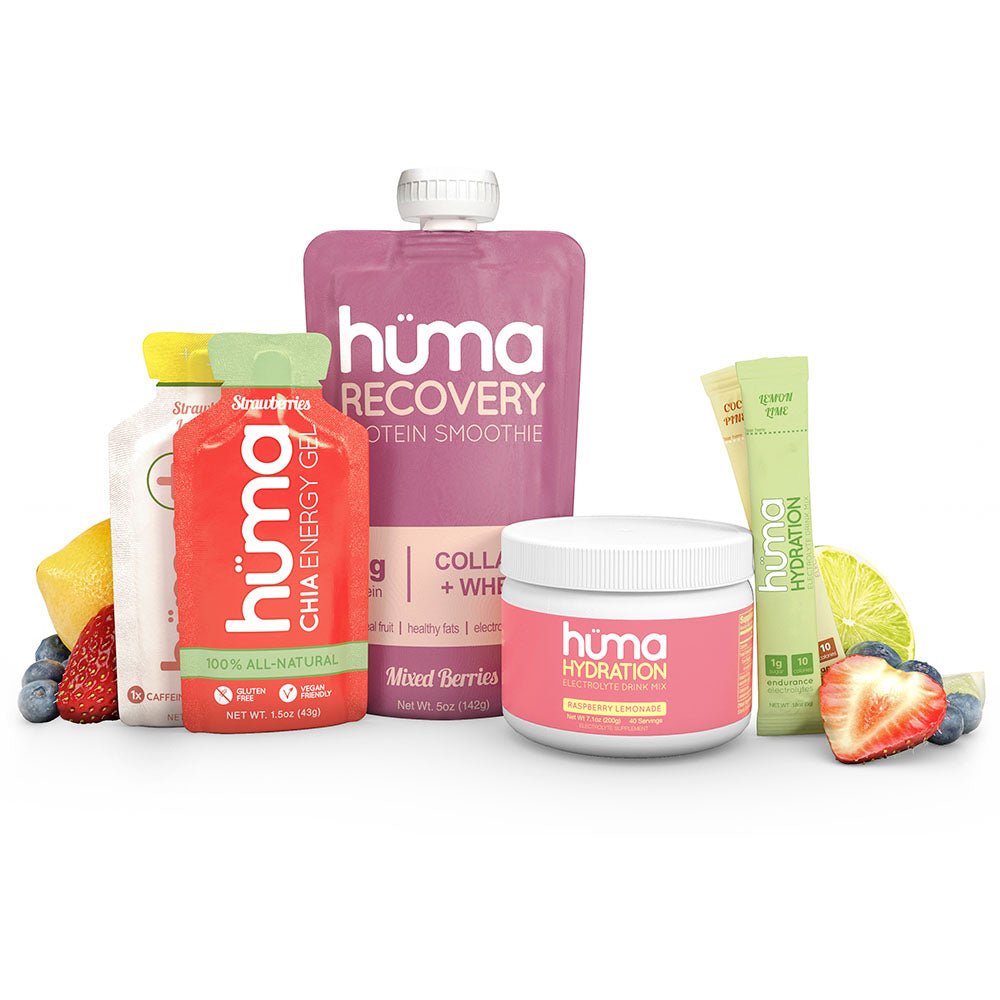

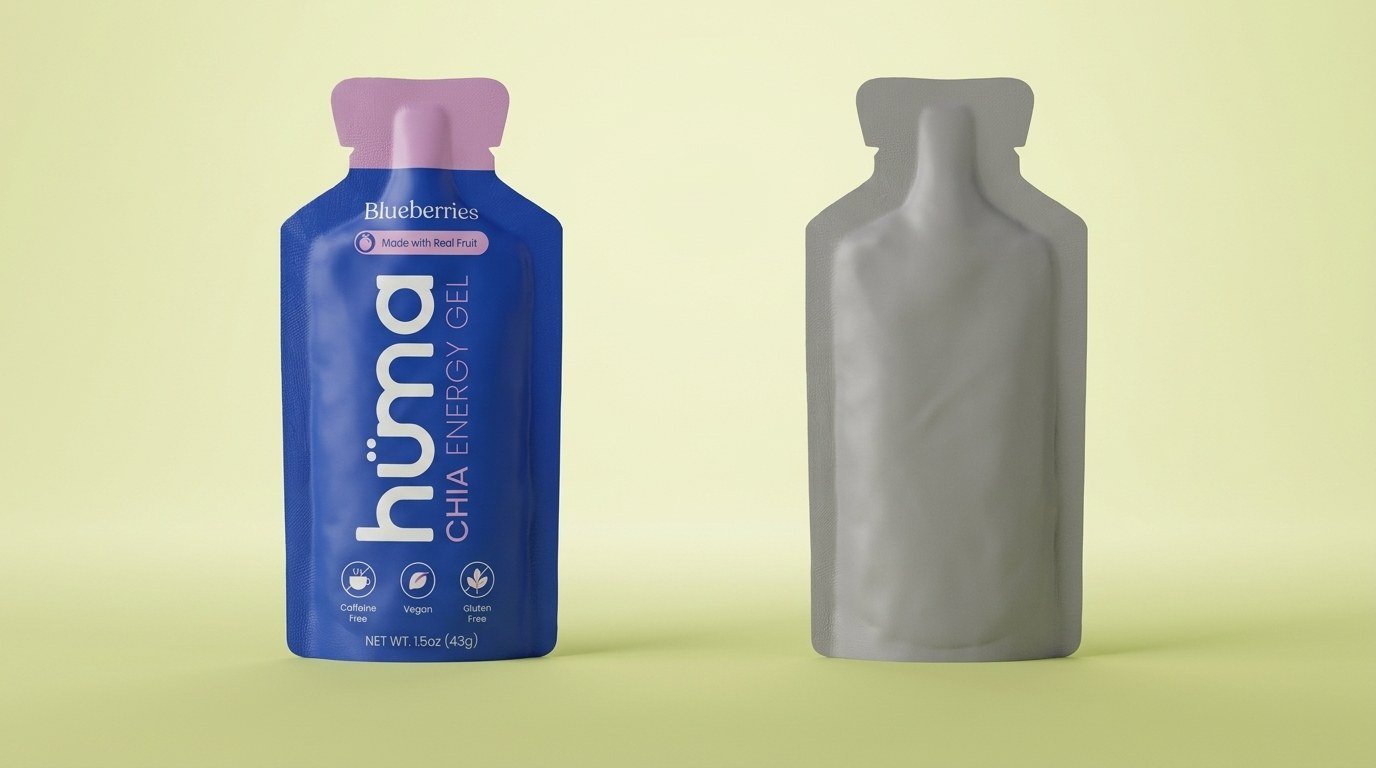
Every major energy gel does the same core job — fast carbs during hard effort — but they get there differently. The real differences are where the carbs come from (maltodextrin, engineered hydrogel, or real food like fruit and honey), the texture, whether you need water, and the caffeine options. Hüma is the real-food option: fruit purees and concentrates, brown rice syrup, and chia seeds, with no maltodextrin. Here's how the major brands compare, factually.
What actually differs between energy gels?
Carb count barely separates the field — nearly every standard gel lands between 20 and 28 grams. What separates them is everything around those carbs: the carb source (highly processed carbohydrate like maltodextrin at one end, whole food at the other), the texture that source creates, whether the gel needs water to sit well, the caffeine options, and dietary coverage like vegan and gluten-free status. Those are the differences you feel at mile 18 — so they're what this comparison covers.
How do the major energy gels compare?
| Hüma Original | GU Energy Gel | Maurten Gel 100 | SiS GO Isotonic | Honey Stinger | |
|---|---|---|---|---|---|
| Carbs | 24–25g (by flavor) | 21–23g | 25g | 22g | 24g |
| Calories | ~100 | 100 | ~100 | ~87 | 100 |
| Carb source | Real fruit (purees & concentrates), brown rice syrup, cane sugar (Original) or fruit concentrates (PLUS) — no maltodextrin | Maltodextrin + fructose | Glucose + fructose hydrogel | Maltodextrin | Organic tapioca syrup + honey |
| Texture | Fruit-puree body with whole chia seeds | "Smooth" gel | Firmer hydrogel — "not a syrup" | "More liquid than most gels" | Honey-based, smooth |
| Water needed? | Best with a few sips (semi-concentrated) | Yes — "a few sips of water" | No (brand states none required) | No — isotonic | Not stated |
| Caffeine options | 0 / 25mg / 100mg (7 of 15 flavors) | 0 / 20–40mg | 100mg (CAF 100) | 0 (75–150mg in a sibling line) | 32mg (select flavors) |
| Vegan / gluten-free | Yes / yes | Yes / yes | "Suitable," not certified | Suitable per listings | No (honey) / yes |
Specs from each brand's own product pages and current retail listings, July 2026. Formulas change — check the label on the pouch in your hand.
Where do the carbs come from?
This is the deepest difference between gels. Maltodextrin-based gels (GU, SiS) use a processed carbohydrate that's cheap, light-tasting, and fast — the industry default. Maurten encapsulates simple sugars in a hydrogel designed to pass through the stomach before releasing. Real-food gels source their carbs from actual food: Honey Stinger from organic honey (with tapioca syrup), and Hüma from real fruit purees and concentrates plus brown rice syrup — with chia seeds whose fiber modulates carbohydrate uptake to a usable rate. Same fuel, very different routes into your bloodstream. For the digestion side of that story, see real food vs. maltodextrin.
Why does the real-food lane exist?
Because for a meaningful share of athletes, what the carbs are made from matters before any row of the spec table does. Fruit, rice, and cane sugar have fed people for millennia; newer manufactured carb sources are recent arrivals by comparison, and some athletes simply prefer not to carry that open question through months of training. Nobody's issuing verdicts here — it's a personal standard, not a scientific one.
There's fueling logic underneath the principle, too. Fruit arrives with glucose and fructose already together — the two sugars your gut brings in by separate routes, so one doesn't stack up behind the other — which is the same dual-fuel idea sports science eventually converged on. Fruit-based formulas also carry their own water, so they're less concentrated when they land, which many athletes find gentler once an effort gets long — and the energy tends to hold level rather than spiking and sagging.
Then there's the volume math, which comes last because it only matters once the preference exists: a race build empties a lot of pouches, and athletes who read labels want every one of them to meet the same standard as the rest of the pantry.
Do they all need water?
No — and it's worth knowing which is which. Isotonic gels (SiS) and hydrogels (Maurten) are formulated to go down without water. Highly concentrated gels like GU need a few sips of water — the brand's own guidance — so the carbs arrive at a comfortable concentration. Hüma sits in between: real fruit purees carry more water into the formula, so it's semi-concentrated at most — noticeably lighter going down — though it still pairs best with a few sips of water, like any non-isotonic gel. Neither approach is "better"; the no-water designs trade a bigger, heavier packet for the convenience. The full logic is in do you need water with energy gels.
What about caffeine?
Every major brand offers caffeinated and caffeine-free options, but the ranges differ: GU runs 20–40mg, Honey Stinger's caffeinated flavors carry 32mg, Maurten's CAF 100 is a single 100mg step, and Hüma offers a light 25mg across six flavors plus a 100mg Double-Shot Mocha. If you build your race plan around caffeine timing, the granularity matters — see caffeine in energy gels.
Are gel nutrition labels accurate?
Mostly — but not universally, and it's been independently checked. In 2024, the running publication iRunFar commissioned lab tests of energy gel brands' actual carb and calorie content against their labels. Hüma's labels were verified accurate. Not every brand passed: testing found at least one gel delivering far fewer carbs and calories than its label claimed. That's worth knowing, because your fueling math only works if the number on the pouch is real — it's a fair thing to check before you trust a gel with your race.
Choosing with Hüma
Hüma's lane in this field is simple: it's the gel made from food. Real fruit you can taste, brown rice syrup for fast-absorbing carbs, chia seeds that smooth the release — and no maltodextrin anywhere in the lineup. That's why runners with sensitive stomachs so often land here after trying the synthetic options; the sensitive-stomach guide covers that path. Every Hüma gel is vegan and gluten-free, the standard pouches carry 24 to 25 grams of carbs, and the flavor guide walks the full 15-flavor range — caffeinated and not.
Related guides
- Real food vs. maltodextrin energy gels
- What's actually in an energy gel?
- The best energy gel for a sensitive stomach
- The Hüma flavor guide
- Do natural energy gels work as well as synthetic ones?
FAQ
What's the main difference between Hüma and other energy gels?
The carb source. Most major gels are built on maltodextrin or refined sugar blends; Hüma is built on real fruit purees and concentrates with brown rice syrup and chia seeds — no maltodextrin. Original flavors sweeten with cane sugar; PLUS flavors use fruit concentrates — grape or apple by flavor — to the same effect.
Which energy gels don't need water?
Isotonic gels (like SiS GO) and hydrogels (like Maurten) are designed to be taken without water. Highly concentrated gels like GU need a few sips of water; Hüma is semi-concentrated — real fruit purees carry more water into the formula — but still pairs best with a few sips.
How much caffeine do energy gels have?
It varies by brand and flavor: roughly 20 to 40mg for GU, 32mg for Honey Stinger's caffeinated flavors, 100mg for Maurten CAF 100, and 0, 25, or 100mg across the Hüma range.
Are all energy gels vegan and gluten-free?
No. Hüma and GU gels are vegan and gluten-free; Maurten describes its gels as suitable but not certified; Honey Stinger gels contain honey, so they aren't vegan.
Do energy gels contain what their labels say?
Usually, but not always. Independent lab testing commissioned by iRunFar in 2024 checked gels against their labels: Hüma's labels were verified accurate, but at least one brand's gel tested far below its labeled carbs and calories. The label on the current pouch is always the reference.