
Yes — energy gels are mostly fast-absorbing carbs, and a good share of that is sugar. For endurance exercise, that's the point, not a flaw. Sugar's bad reputation comes from sitting still and overdoing it; during a hard, prolonged effort your working muscles burn through glucose and want it back fast. The real question isn't whether there's sugar — it's whether you're using it for the one job it's genuinely built for.
Is there sugar in energy gels?
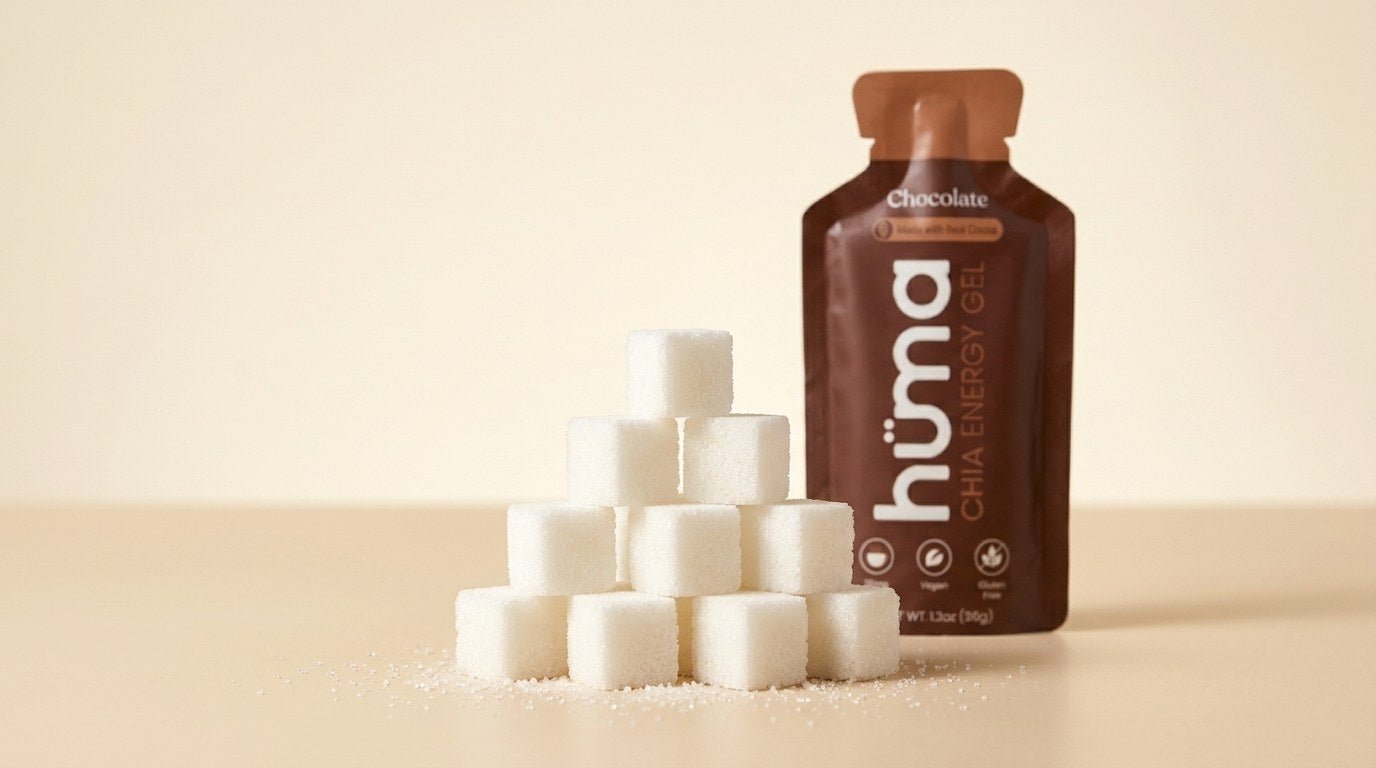
Yes. Most energy gels are built around fast carbs, and much of that is sugar. A Hüma Original or PLUS gel carries 24 grams of carbs — roughly 15 of them sugar — while Ultra packs 40 grams for high-carb fueling. That concentrated dose is the whole design: a small pouch you can take on the move that puts usable carbs into your bloodstream quickly. For the full parts list, see what's actually in an energy gel.
Why does sugar have a bad reputation?
Most of the case against sugar is about everyday life — steady snacking, sweetened drinks, and big loads of sugar while you're mostly sitting still. In that setting the concern is spiking your blood sugar when your body isn't using the fuel. Endurance exercise flips the situation completely: you're not storing that sugar, you're burning it — often about as fast as you can take it in, if not faster.
Why sugar is the right fuel for endurance
During hard, prolonged effort your muscles run largely on carbs, and your body only stores a limited amount as glycogen — enough for roughly 90 minutes to two hours. Once you start drawing that tank down, taking in fast carbs keeps your blood sugar and your pace from fading late. Sugar is simply the quickest way to get glucose to working muscles, which is why every endurance fuel — gels, drinks, chews — leans on it. It's the same reason how many carbs per hour you need climbs the longer you're out there. This holds whether you're a runner, a cyclist, or a triathlete.
Sugar at rest vs. sugar during endurance
| Sitting still | During a hard effort | |
|---|---|---|
| What happens to the sugar | Stored; can spike blood sugar | Burned as fuel by working muscles |
| What your body wants | Less, and steady | Fast carbs, replaced regularly |
| The right amount | Minimal | ~30–60g of carbs per hour |
How much sugar do you actually need?
For most endurance athletes, two to three gels per hour — roughly 30 to 60 grams of carbs — covers it. That's dose-matched to what you're burning, not a free pass. Take in more than your gut can absorb and the extra just sits there and causes trouble; the goal is matching intake to the effort. Off the trail, a gel isn't a snack — it's fuel for when you're actually working.
The sugar in Hüma
Hüma's fast carbs come from real-food sources — brown rice syrup with real fruit purees and concentrates — so the sugar arrives alongside real fruit and chia rather than from a processed starch. Original flavors sweeten with cane sugar; PLUS flavors use fruit concentrates — grape or apple by flavor — to the same effect. That sourcing is a lot of the why: cane sugar and fruit are sugars people have fueled with for thousands of years, a record the newer manufactured carbs haven't had time to build — which many athletes count as reason enough; it's a preference, not a lab result. Fruit also brings glucose and fructose as a matched pair, each with its own door into your system, so neither backs the other up. Each Original gel is 24 grams of carbs, with more water in the formula than a thick syrupy gel, so it goes down smooth even when you're taking one every 20 to 30 minutes. Reach for it when you're working — and, like any fuel, use it for the effort, not the couch.
Related guides
- Sugar spike vs. steady energy: why some gels crash you
- Real food vs. maltodextrin energy gels
- How many carbs per hour for a marathon
- What's actually in an energy gel?
- Is there an energy gel made from real fruit?
FAQ
Is there sugar in energy gels?
Yes — most are built around fast carbs, much of it sugar. A Hüma Original gel has 24 grams of carbs, about 15 of them sugar. That concentrated dose is the design: fast fuel you can take on the move.
Is the sugar in energy gels bad for you?
For endurance exercise it's the right fuel, not a problem — your working muscles burn through glucose and want it back fast. Sugar's downsides are about sedentary over-consumption, not fueling a hard effort. Use gels for exercise, not as an everyday snack.
Why do endurance athletes eat so much sugar?
Because working muscles run on carbs and your glycogen stores only last about 90 minutes to two hours. Fast sugar is the quickest way to get glucose to the muscles and keep your pace from fading late.
How much sugar should you take during a race?
Match it to the effort — about two to three gels (30 to 60 grams of carbs) per hour for most endurance athletes. More than your gut can absorb just causes stomach trouble.
Does Hüma use real sugar?
Yes — Hüma's fast carbs come from real-food sources: brown rice syrup and real fruit purees and concentrates, plus chia. Original flavors sweeten with cane sugar; PLUS flavors use fruit concentrates — grape or apple by flavor — to the same effect. Made in the USA.