
Plan on two to three gels per hour, and let your finish time set the total: roughly two to four gels for a half marathon, five to eight for a marathon — more like eight to ten if you're out near five hours — and a steady per-hour rhythm rather than a fixed total for an ultra. The math behind it is simple: 30 to 60 grams of carbs an hour, at 20 to 25 grams per gel.
How do you figure out how many gels you need?
Start with time, not distance. Most endurance athletes — runners, cyclists, and triathletes — target 30 to 60 grams of carbs per hour on efforts past about an hour, and a standard energy gel carries 20 to 25 grams. That works out to two to three gels per hour. Then trim the edges: your first gel lands around 30 to 45 minutes in, and your last useful one about 20 to 30 minutes before the finish, since carbs take 10 to 15 minutes to reach your bloodstream. Multiply your hours by your rate, subtract the warm-up and the finish, and you have your number. For the timing details, see when to take your first gel; for the per-hour target, how many carbs per hour you need.
How many gels by distance?
| Race | Typical finish time | Gels |
|---|---|---|
| 5K / 10K | 15–60 min | None mid-race — arrive topped off instead |
| Half marathon | 1:20–2:30 | ~2–4 for most; sub-90 finishers often none |
| Marathon | 3–5+ hr | ~5–8; up to 10 near five hours |
| Ultramarathon | 6+ hr | No fixed total — 2–3 per hour, mixed with real food |
How many gels for a half marathon?
Most half-marathoners finish between two and two and a half hours, which puts the answer at two to four gels: the first around 45 minutes in, then one every 20 to 40 minutes. Faster runners closer to two hours may only want one or two, and racers finishing well under 90 minutes can usually skip mid-race gels entirely — their stored carbs cover it, as long as they show up with the tank full. The distance-by-distance logic is in do you need gels for a 5K, 10K, or half marathon.
How many gels for a marathon?
A marathon runs long past the 90-minutes-to-two-hours your stored carbs can carry, so the per-hour rhythm has to hold the whole way. Here's what two to three gels per hour looks like by finish time:
| Marathon finish time | Gels (at 2–3 per hour) |
|---|---|
| 3:00 | 4–6 |
| 3:30 | 5–7 |
| 4:00 | 6–8 |
| 4:30 | 7–9 |
| 5:00 | 8–10 |
Carry one more than the plan calls for — a dropped pouch or a longer day than expected shouldn't end your fueling. And write the schedule down or set a watch alarm; mid-race math is nobody's strength at mile 18. For the full race-day plan, see how to fuel your first marathon.
How many gels for an ultra?
An ultra doesn't get a total — it gets a rate. Plan two to three gels per hour as the steady base, then mix in aid-station food and real snacks so your stomach and taste buds last the distance. Over a very long day many runners settle slightly lower than they would in a marathon, simply because the gut gets tired. The full approach — variety, electrolytes, flavor rotation — is in how to fuel for an ultramarathon.
Should you count a pre-race gel?
No — treat it separately. A gel 10 to 15 minutes before the gun is a top-off that gets carbs ready to go as you start; it doesn't change your in-race rhythm, and your first mid-race gel still lands 30 to 45 minutes in. Whether to take one at all is covered in should you take a gel before the race starts.
Can you take too many gels?
There's a ceiling. From a single carb source your gut absorbs around 60 grams per hour — beyond that, the extra just sits there, which is where sloshing and stomach trouble start. A glucose-and-fructose mix lets trained athletes push toward 90 grams, but that rate has to be trained into your gut first. If you're new to fueling, start at the low end and build up — more on the limits in can you take too many energy gels.
Counting out your race with Hüma
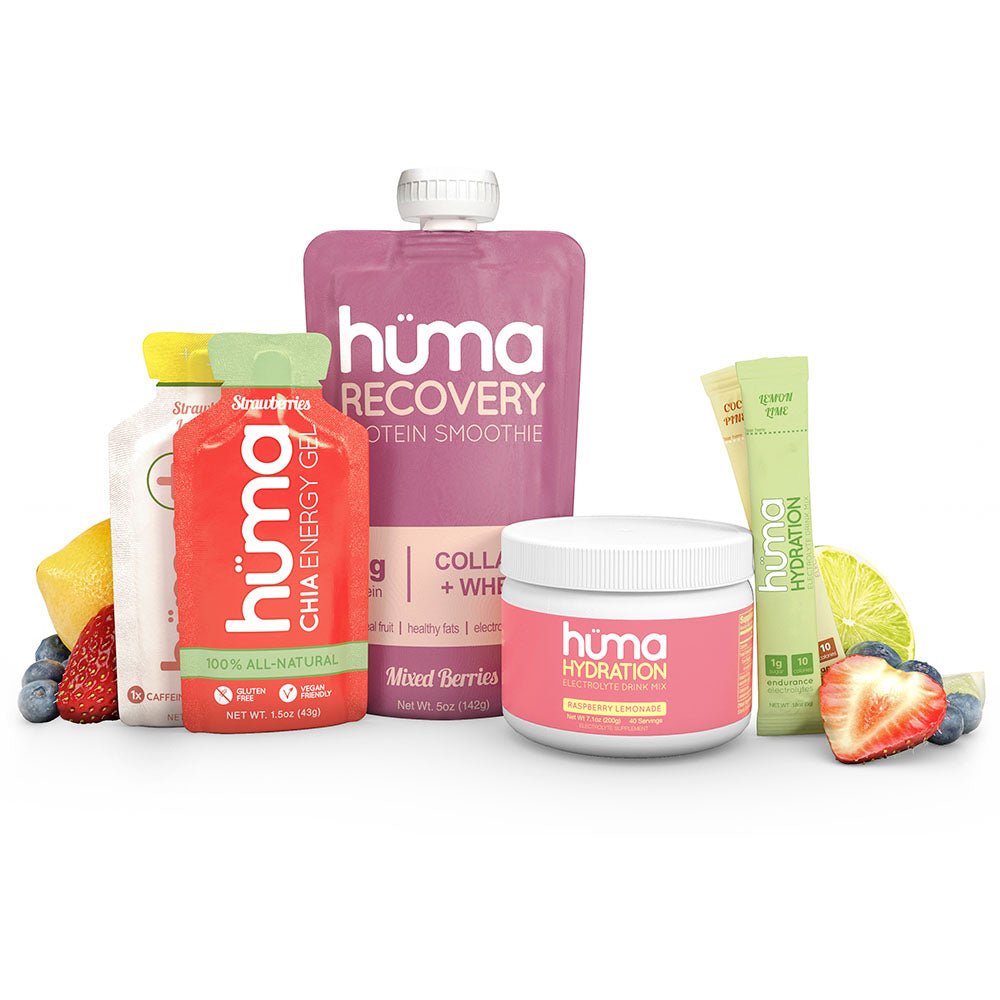
Hüma keeps the arithmetic clean: about 24 grams of real-food carbs per gel — from brown rice syrup and real fruit purees, with chia — so two to three per hour covers the 30-to-60-gram target most runners aim for. For a half, that's a pocketful; for a marathon, five to eight or so; for an ultra, a steady stream. When you'd rather carry fewer pouches, the 40-gram Ultra covers the same hourly target with less to hold. There's more water in the formula than a thick syrupy gel, so number six goes down as smooth as number one. Practice the count on your long runs, and race day is just following the plan.
Related guides
- How many carbs per hour for a marathon
- How to fuel your first marathon
- Can you take too many energy gels?
- How to fuel for an ultramarathon
- Do you need gels for a 5K, 10K, or half marathon?
FAQ
How many energy gels should you take for a marathon?
Most runners take five to eight gels — two to three per hour, starting 30 to 45 minutes in — and closer to eight to ten if you're out near five hours. Carry one spare beyond the plan.
How many gels do you need for a half marathon?
Two to four for most runners, with the first around 45 minutes in. Faster finishers may want just one or two, and runners under about 90 minutes can usually skip mid-race gels if they arrive topped off.
How many gels do you need for an ultramarathon?
There's no fixed total — plan two to three gels per hour as a steady base and mix in real food so your stomach and palate last the whole day.
Does a pre-race gel count toward your total?
No. A gel 10 to 15 minutes before the start is a separate top-off that gets carbs ready to go. Your in-race rhythm still begins 30 to 45 minutes in.
Can you take too many gels?
Yes — from a single carb source your gut absorbs about 60 grams per hour, and extra carbs beyond that just sit in your stomach. Trained athletes using a glucose-and-fructose mix can push toward 90 grams, but only after building up in training.