
Yes — an energy gel breaks a fast. A standard gel is 20 to 25 grams of fast carbs, about 100 calories, and any fast that counts calories ends the moment you swallow one. No loophole, no "technically." The more useful questions are the two hiding behind this one: where does a gel fit if you train fasted — and what actually happens if you eat one without exercising? Short answers: as the workout's fuel, and not much.
Do energy gels break a fast?
Yes, plainly. A gel is food — concentrated, pocket-sized, fast-absorbing food, but food. At roughly 100 calories and 20 to 25 grams of carbs, it clears any reasonable definition of "breaking a fast" by a wide margin. If the fast you're keeping counts calories, a gel counts against it, the same as a banana or a spoonful of honey would. Whatever your reasons for fasting — that's your call, and none of our business. The fueling math is our business, and the math is unambiguous: one pouch, fast is over.
Where does a gel fit if you run fasted?
Plenty of endurance athletes — runners, cyclists, triathletes — train early, before their eating window opens, and here's the reframe that makes the whole question simpler: a gel taken mid-run isn't a snack that broke your fast; it's the workout's fuel. Those are different jobs. The snack question is "do I want to eat?" The fuel question is "does this effort need carbs?" — and that one has real answers:
- A fasted easy run under an hour usually doesn't need a gel at all. Your body has the fuel on board for that. If keeping the fast intact matters to you, this is the run where it genuinely can stay intact — see how early is too early to fuel.
- A long run or hard workout needs carbs regardless of when you last ate — and arguably more so on an empty morning, since you're starting with less in the tank. Take the gel when the effort calls for it, not on a snack schedule: when to take your first gel covers the timing.
In other words: don't take a gel to make a fasted run feel virtuous, and don't skip one to keep a streak alive when the workout actually needs fuel. The effort decides. If you're still building the bigger picture of what needs fueling and what doesn't, start with Endurance Nutrition 101.
What happens if you eat an energy gel without exercising?
Nothing dangerous — and honestly, not much of anything. A gel is real food in a squeeze pouch, not a potion; eating one at your desk is nutritionally about as eventful as eating a fruit snack. But it's worth being clear-eyed about what you're getting: a gel is fuel engineered for working muscles — fast carbs, sized and timed for the middle of an effort. Sitting still, there's no effort for those carbs to fuel, so it's simply 100 calories of fast-arriving carbs. Your body stores what it doesn't use, and because the carbs arrive quickly, some people feel a bit of a slump once they've settled. It's the fueling equivalent of putting race tires on a parked car: nothing breaks. Nothing much happens, either. Curious what's actually in the pouch? What's actually in an energy gel opens it up, and is the sugar in energy gels bad answers the question usually lurking behind this one.
So when does a gel make sense — and when doesn't it?
| Scenario | Does a gel break the fast? | The honest call |
|---|---|---|
| Strict calorie-counted fast, no training | Yes | Save it for a run |
| Fasted easy run, under an hour | Moot — you likely don't need one | Skip it; the fast survives |
| Fasted long run or hard workout | Yes, and that's fine | Take it — it's the workout's fuel, doing its actual job |
| 3 p.m. desk craving | Yes | Won't hurt you; won't do much for you either |
Why "gels are for motion" is the honest framing
There's no rule against eating a gel on the couch — it's food, and nothing about it requires a race bib. But everything about a gel is designed around movement: the carb dose matched to what working muscles burn, the speed of absorption, the pouch built for a shorts pocket at mile 16. Eaten mid-effort, those design choices all pay off — the carbs arrive in 10 to 15 minutes and go straight to work. Eaten in a desk chair, the same design just means the sugar shows up quickly to a job site where nobody's working. Real food deserves a better gig than that.
Fasted training, with Hüma
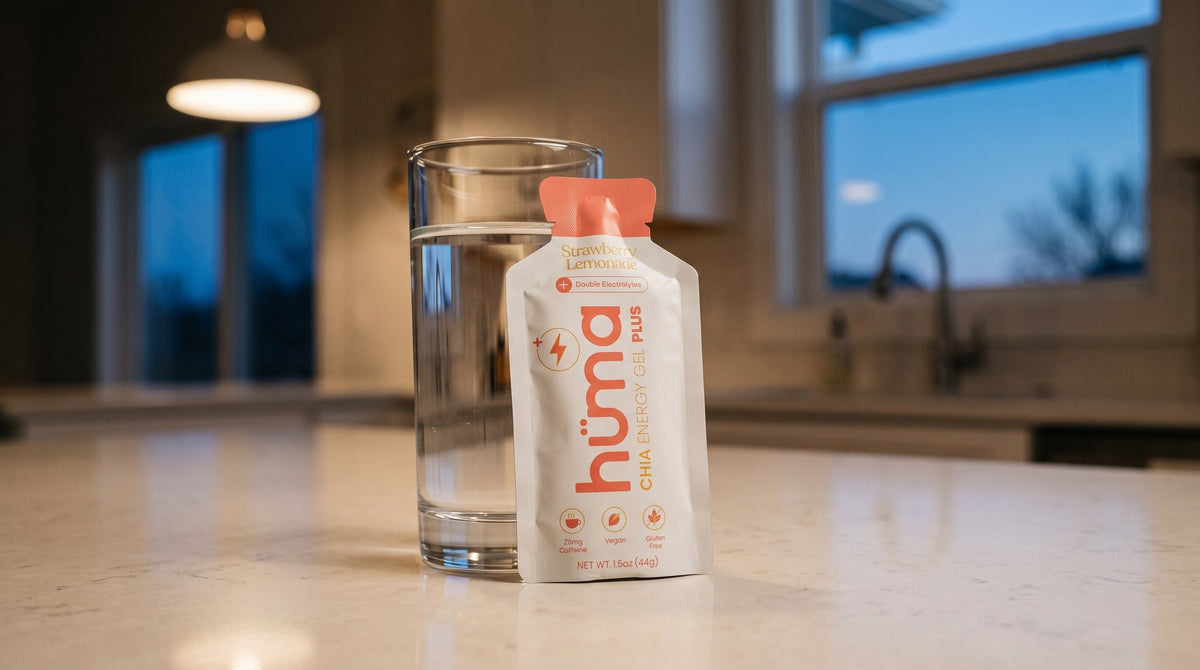
If the ingredient list is part of why you care about this question, Hüma's is short and recognizable: real-food carbs from brown rice syrup and real fruit purees, with chia. 24 grams of carbs per pouch, built for the middle of an effort. For the fasted-morning crowd, the playbook is the one above: easy hour, no gel needed; long or hard, two to three per hour once the effort calls for fuel, starting 30 to 45 minutes in. And if one occasionally disappears at your desk because Strawberries sounded good at 3 p.m. — we understand completely. We just think it's happier at mile 16.
Related guides
- When to take your first gel — and how often after
- How early is too early to fuel?
- Endurance Nutrition 101: the basics of fueling
- What's actually in an energy gel?
- Is the sugar in energy gels bad for you?
FAQ
Does an energy gel break intermittent fasting?
Yes. A gel is about 100 calories and 20 to 25 grams of carbs, which ends any calorie-counted fast. If you train fasted, think of a mid-run gel as the workout's fuel rather than a fast-breaking snack — and take it only when the effort actually needs carbs.
Can you run fasted without taking a gel?
For an easy run under an hour, usually yes — your body has that much fuel on board. Longer or harder efforts need carbs no matter when you last ate, so take a gel when the workout calls for it rather than forcing the fast through a long run.
What happens if you eat an energy gel and don't work out?
Nothing dangerous — a gel is real food, and eating one at rest is about as eventful as a fruit snack. Without working muscles to fuel, it's simply 100 calories of fast carbs: your body stores what it doesn't use, and some people feel a bit of a slump after.
How many calories are in an energy gel?
Most single-serve gels run about 100 calories from 20 to 25 grams of carbs. Huma Original and PLUS carry 24 grams per pouch; higher-carb gels built for long efforts carry more.
Are energy gels only for athletes?
They're food, so anyone can eat one — but everything about a gel is designed for fueling movement: fast carbs, mid-effort dosing, a pouch made for a shorts pocket. As an everyday snack it's an odd fit; as mid-run fuel it's exactly right.