
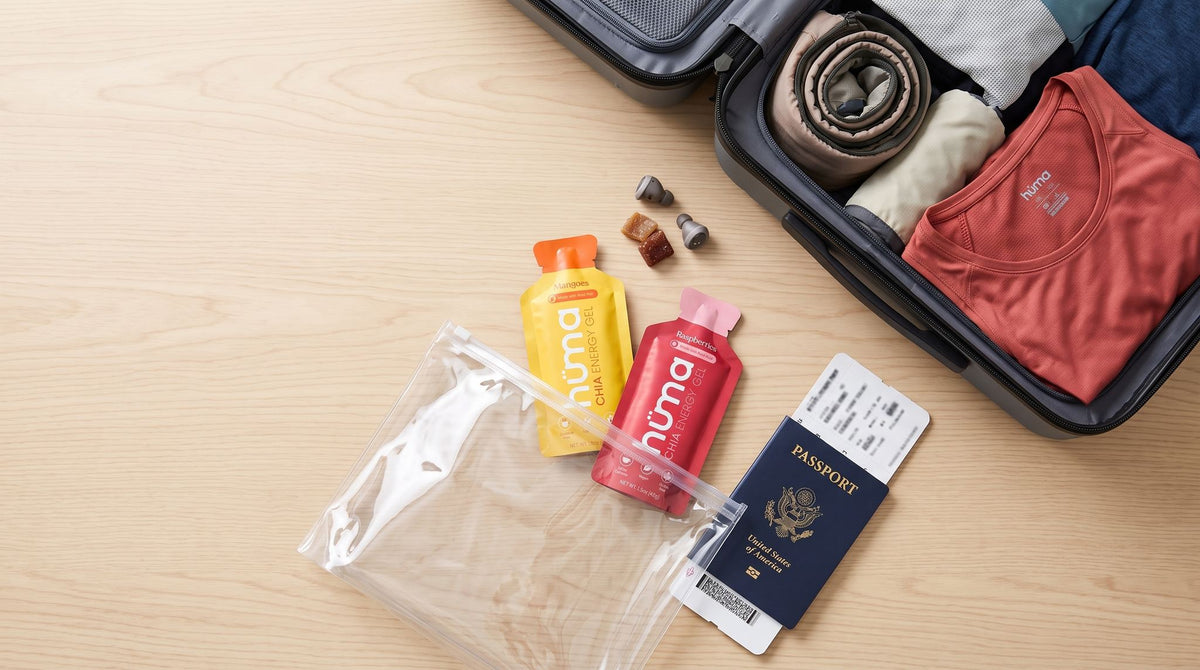
Yes — you can fly with energy gels. In a carry-on, gels count as liquids under TSA's 3-1-1 rule: containers of 3.4 ounces (100 milliliters) or less, all fitting in one quart-size bag — and a standard single-serve gel pouch sits well under that line. In a checked bag there's no limit at all. Put race-day gels in the quart bag, check the rest, and build in a backup.
What do TSA's rules actually say about energy gels?
Two pieces of TSA guidance apply, and they don't perfectly agree — which is why the internet answers this question six different ways. The first is the liquids, aerosols, and gels rule (the "3-1-1" rule, published on tsa.gov): anything that isn't fully solid at room temperature — liquids, gels, creams, pastes — goes in your carry-on only in containers of 3.4 ounces (100 ml) or less, all inside one quart-size resealable bag. Energy gels are gels, and a single-serve pouch holds far less than 3.4 ounces, so under this rule they're carry-on legal in the quart bag. The second is TSA's "What Can I Bring?" item lookup, which has listed gel-type supplements as items for checked bags. So which one governs your pouch of fast carbs? TSA's own bottom line settles the tie: the officer at the checkpoint makes the final call on any item. Plan around that, and you'll be fine either way.
What actually happens at security?
In practice, gels fly. Endurance athletes travel with them constantly — race weekends are basically a migration — and the consistent report from runners, cyclists, and triathletes is that single-serve pouches in the quart bag go through without a second look. Occasionally a bag gets pulled for extra screening, the officer swabs or eyeballs the pouches, and everyone moves on. What reliably causes problems isn't the pouches — it's large containers: bulk gel bottles and big refillable flasks over 3.4 ounces are over the carry-on limit, full stop. Those go in checked luggage. The calm play: keep carry-on gels in the quart bag where they're clearly declared, don't bury them loose in the bottom of a backpack, and accept that one officer in fifty may interpret the rules more strictly. That's not a crisis; that's why you packed a backup.
How should you pack gels for a flight?
| What you're carrying | The play |
|---|---|
| Race-day gels (a handful) | Carry-on, inside the quart-size liquids bag |
| The bulk of your stash | Checked bag — no quantity or size limit |
| Bulk bottles or flasks over 3.4 oz | Checked bag, no exceptions |
| Gels for a destination race | Split between carry-on and checked, plus a backup plan |
The quart bag isn't big, but it doesn't need to be — it comfortably holds the gels for race day itself. If you're still working out how many that is, how many gels for a marathon, half, or ultra does the math.
What about international flights?
Most countries run a rule very similar to TSA's: liquids and gels in carry-on limited to 100 ml containers in one clear bag. Some airports have begun relaxing liquid rules as newer scanners roll out, but the rollout is uneven and can differ between your outbound and return airports — so pack for the strictest leg of the trip. The checked-bag route works everywhere. One genuine international caveat: a few countries restrict certain food imports, so if you're traveling somewhere with strict biosecurity rules (Australia and New Zealand are the classic examples), declare food items on arrival and let the officer wave them through.
What's the backup plan for a destination race?
Never let one bag hold your entire race plan. Three layers, in order of effort:
- Split the supply. Race-day gels in the carry-on quart bag, duplicates in the checked bag. If either bag has a bad day, the plan survives.
- Ship ahead. For a big goal race, mailing gels to your hotel a week out removes the airport from the equation entirely.
- Buy at the expo — carefully. Race expos sell gels, but only fall back on this for a brand and flavor you've already trained with. Race morning is not the moment for a new variable — and neither is the rest of the routine: what to eat the morning of a race shouldn't change just because you slept in a hotel.
Flying with Hüma
Hüma gels are built for exactly this kind of trip. They're heat-pasteurized and shelf-stable with a 3-year shelf life — about a year longer than most energy gels — so a checked bag, a hotel nightstand, or a week in a suitcase costs them nothing. The pouches are standard single-serve gel pouches, comfortably inside the carry-on container limit. Pack race-day pouches in the quart bag, check the training stash, and once you land the usual rules apply: how to store energy gels covers the hotel-room logistics (short version: not on the sunny windowsill). Real-food carbs from brown rice syrup and real fruit travel just fine at 35,000 feet.
Related guides
- How many energy gels for a marathon, half, or ultra?
- How to store energy gels
- What to eat the morning of a race
- How to carry gels on a run
- Endurance Nutrition 101: the basics of fueling
FAQ
Can you bring energy gels in a carry-on?
Yes. Under TSA's 3-1-1 liquids rule, gels are allowed in carry-on in containers of 3.4 ounces (100 ml) or less, all inside one quart-size bag — and single-serve gel pouches are well under that limit. The checkpoint officer always has the final say, so keep a backup in your checked bag.
How many energy gels can you take through security?
As many as fit in your one quart-size liquids bag — which comfortably covers a race day's worth. For a full training stash, use your checked bag, where there's no limit.
Can you put energy gels in checked luggage?
Yes, with no quantity or size restrictions. Checked baggage is the certain route — bulk boxes, big flasks, and anything over 3.4 ounces all go there.
Do energy gels count as liquids for TSA?
Yes. Anything that isn't fully solid at room temperature falls under the liquids rule, and gels are named in it explicitly. Treat every pouch like a travel-size toiletry: in the quart bag.
What if security confiscates your gels before a race?
This is rare with pouches in the quart bag, but it happens — officers have discretion. Protect the race by splitting gels between carry-on and checked bags, shipping a supply to your hotel ahead of time, or knowing which brand and flavor you'd buy at the expo as a tested fallback.