

Whether you need a gel for HYROX comes down to one number: how long you'll be out there. HYROX is eight 1K runs alternating with eight workout stations, and most finishers take anywhere from about an hour to two. If you're finishing under 75 minutes or so, you can run the whole thing on what you ate beforehand. Longer than that — or racing a doubles-plus-singles day — and a mid-race gel or two starts to earn its place.
What is HYROX, and why does the format matter for fueling?
HYROX is a fitness race: eight rounds, each a 1K run followed by a functional station — SkiErg, sled push, sled pull, burpee broad jumps, rowing, farmers carry, sandbag lunges, and a closing set of wall balls. Everyone does the same stations in the same order, and finish times usually land somewhere between an hour for competitive athletes and two hours for first-timers. That time window is the whole fueling question, because it straddles a line your body cares about.
Where does HYROX sit on the fueling line?
Right on the boundary. Your body stores carbs as glycogen, and that tank holds roughly 90 minutes to two hours of hard effort — the same limit behind bonking in any endurance sport. A HYROX race lands squarely across that line, which is exactly why the answer isn't one-size-fits-all:
- Finishing under about 75 minutes? You're inside the tank you brought. A good pre-race meal covers the whole race, and a mid-race gel is optional at most.
- Closer to two hours, or beyond? Now you're spending down toward the bottom of the tank, and topping it up mid-race keeps the back half from falling apart.
- Racing doubles then singles, or stacking heats in one day? The clock adds up across the day even if one race is short — that's where mid-race and between-race carbs matter most.
If fueling is new to you, endurance nutrition 101 lays out the basics that sit under all of this.
What should you eat before a HYROX race?
This is the part that matters for everyone, short race or long: show up fueled. A carb-focused breakfast two to four hours before your heat tops off your glycogen, with an optional small top-up closer in. Keep it familiar — nothing new on race day — and don't go heavy on fat or fiber right before you race. Do that, and a sub-75-minute race is largely handled before the first run even starts. The full pre-race plate is in what to eat the morning of a race.
When do you actually take a gel mid-race?
The stations are no place to fuel — you can't swallow a gel mid-wall-ball or halfway through a sled push, and you wouldn't want to. Take it on a run segment or in the roxzone, the transition area between a station and the next run, where you're moving at a steadier, lower effort and can actually get it down with a sip of water. A gel's carbs reach your bloodstream in about 10 to 15 minutes, so one taken around the halfway point — say, heading out on run four or five — is landing right as the back half gets hard. For a two-hour race, one or two across the race is plenty; there's no need to fuel every round like it's a marathon.
How should you time caffeine for HYROX?
Caffeine is an optional layer on top of the fuel, and its usefulness is all about timing. It takes roughly 30 to 45 minutes to fully kick in, so a caffeinated gel at the start line is peaking somewhere mid-race — fine, but you can aim it better. If you want the lift for the grind — the row, the lunges, that final wall-ball set — a caffeinated gel taken partway through times the peak for the back half, when it counts most. Caffeine in energy gels covers the dosing landscape, and if caffeine isn't your thing, you lose nothing on fuel by skipping it — are caffeine-free gels worth it makes that case.
Fueling HYROX with Hüma
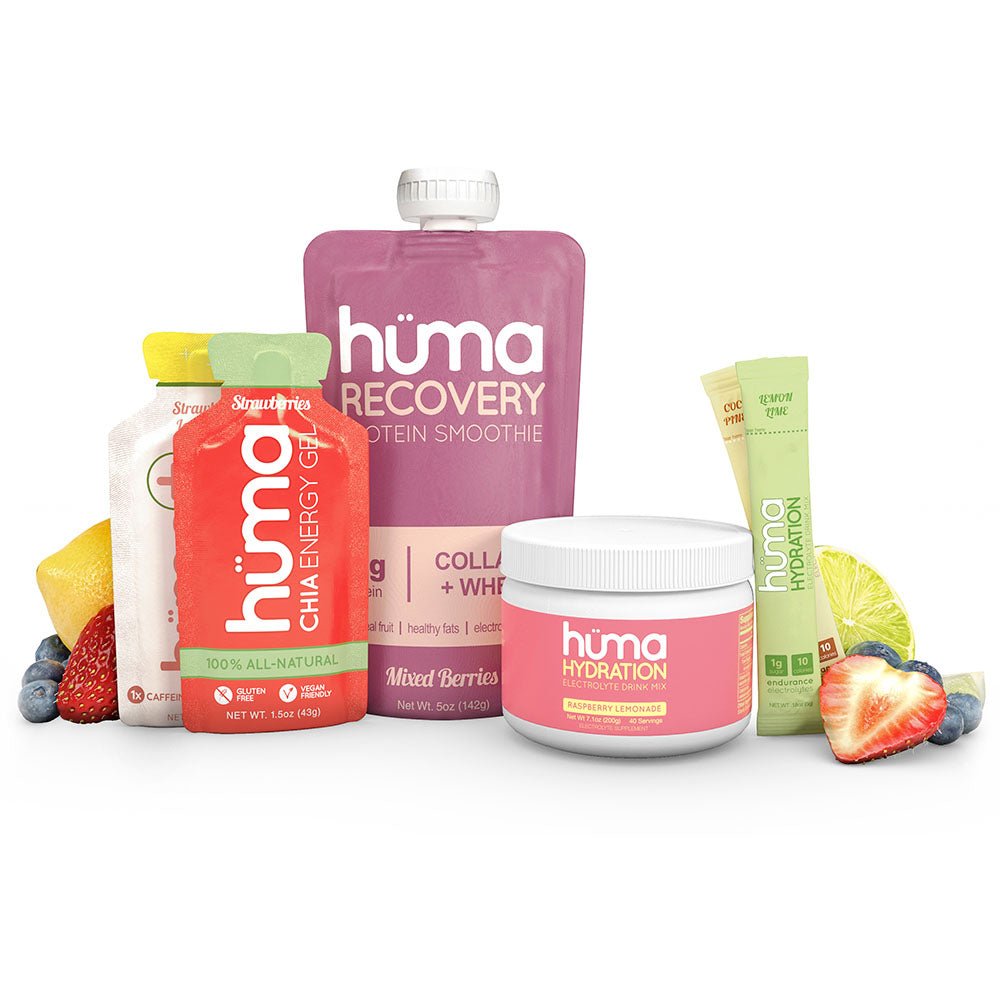
For a race that's mostly about arriving fueled and topping up once or twice, Hüma fits the job cleanly. Each pouch is 24 grams of real-food carbs from brown rice syrup and real fruit purees and concentrates, with chia — and because the fruit carries more water into the formula, a Hüma is semi-concentrated, lighter going down than a thick, syrupy gel. That matters when you're breathing hard in the roxzone and need it to go down easy with a sip of water. Eight of the 15 gel flavors are caffeine-free, so your fuel doesn't have to carry a buzz you didn't want; the caffeinated flavors bring a light 25mg, and Double-Shot Mocha brings 100mg if you want a real kick for the back half. On a hot race day, PLUS doubles the electrolytes for the extra sweat — no change to the carbs.
Related guides
- What is bonking, and how do you avoid it?
- What to eat the morning of a race
- Caffeine in energy gels: how much and when
- Endurance Nutrition 101: the basics of fueling
FAQ
Do you need energy gels for HYROX?
Only if you're out there long enough. Finishing under about 75 minutes, you can run the whole race on a good pre-race meal. Closer to two hours, or racing doubles plus singles in a day, a mid-race gel or two keeps the back half strong.
When should you take a gel during HYROX?
On a run segment or in the roxzone between stations — never mid-station, where you can't swallow one anyway. Around the halfway point works well: the carbs land in 10 to 15 minutes, right as the back half gets hard.
What should you eat before HYROX?
A carb-focused meal two to four hours before your heat, with an optional small top-up closer in. Keep it familiar and go easy on fat and fiber. That alone covers a short race; longer races add a mid-race gel on top.
Should you use caffeine for HYROX?
It's optional. Caffeine takes 30 to 45 minutes to fully kick in, so a caffeinated gel taken partway through peaks for the back half — the row, the lunges, the final wall balls. Plenty of racers skip caffeine and fuel exactly the same on the carbs.
How many gels for a HYROX race?
Not many. A two-hour race is well covered by one or two gels plus your pre-race meal. There's no need to fuel every round — HYROX sits near the edge of your stored-carb tank, not deep past it like a marathon.